Topic 6 of 7
Disubstituted cyclohexanes
Conformations notes: Disubstituted cyclohexanes, explained step by step, with 1 worked example.
| Pattern | cis | trans |
|---|---|---|
| 1,2 | a,e or e,a | e,e or a,a |
| 1,3 | e,e or a,a | a,e or e,a |
| 1,4 | a,e or e,a | e,e or a,a |
Which chair, which isomer
- Put the larger group equatorial if you must choose.
- The isomer that can have both groups equatorial is the more stable one: trans-1,2, cis-1,3, trans-1,4.
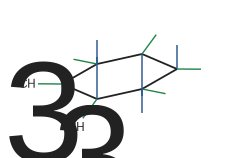
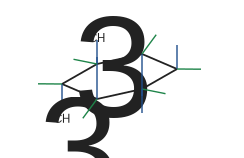
- cis-1,2-dimethylcyclohexane: both chairs have one axial and one equatorial methyl: strain 3.8 (gauche) + 7.6 (axial ) = 11.4 kJ/mol; the two chairs are equal in energy.
- trans-1,2-dimethylcyclohexane: e,e (3.8 kJ/mol, one gauche interaction) vs a,a (four 1,3-diaxial interactions, 15.2 kJ/mol). The e,e chair is favoured by 11.4 kJ/mol.
Worked example: cis-1-tert-Butyl-4-chlorocyclohexane
Which chair is more stable, and by how much?
Show answer and solution
In the cis-1,4 isomer one group is axial. With t-Bu equatorial and Cl axial: strain = 2 x 1.0 = 2.0 kJ/mol. With t-Bu axial and Cl equatorial: 2 x 11.4 = 22.8 kJ/mol. The first chair is favoured by about 20.8 kJ/mol.
When the chair gives up
cis-1,4-Di-tert-butylcyclohexane would need one axial tert-butyl in any chair. It adopts a twist-boat so that both groups can be pseudo-equatorial.