Cyclohexane
Conformations notes: Cyclohexane, explained step by step.
Ring strain (Baeyer)
Baeyer (1885) assumed planar rings and predicted angle strain from the deviation of the ring angle from 109.5: cyclopropane 60, cyclobutane 90, cyclopentane 108, planar cyclohexane 120. Real rings (except cyclopropane) pucker to reduce strain. Total ring strain has three parts: angle strain, torsional strain (eclipsing) and steric strain.
| Ring | Strain (kJ/mol) | Shape |
|---|---|---|
| cyclopropane | 115 | planar, bent "banana" bonds, all C-H eclipsed |
| cyclobutane | 110 | puckered (folded about 25) |
| cyclopentane | 26 | envelope |
| cyclohexane | 0 | chair |
The chair
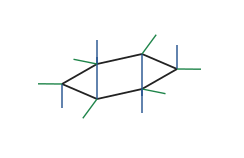
The chair is free of angle and torsional strain. Each carbon has one axial bond (parallel to the ring axis, alternating up and down) and one equatorial bond (roughly in the ring "plane").
- Draw two parallel lines slanting upward, starting at the same height.
- Join the top ends with a V (longer left arm); join the bottom ends with an inverted V (shorter left arm).
- Axial bonds are vertical, alternately up and down.
- Each equatorial bond is parallel to the ring bonds once removed from it.
Ring flip
The two chairs interconvert rapidly (barrier about 45 kJ/mol) through the half-chair, twist-boat and boat forms. In a ring flip every axial bond becomes equatorial and every equatorial bond becomes axial, but "up" stays up and "down" stays down.
| Conformation | Relative energy (kJ/mol) |
|---|---|
| chair | 0 |
| twist-boat | 23 |
| boat | 29 (flagpole H atoms clash; all bonds on two sides eclipsed) |
| half-chair | 45 (top of the barrier) |