Topic 5 of 7
Monosubstituted cyclohexanes
Conformations notes: Monosubstituted cyclohexanes, explained step by step, with 1 worked example.
A substituent prefers the equatorial position. An axial group suffers 1,3-diaxial interactions with the two axial H atoms on C3 and C5 (each equivalent to a gauche butane interaction).
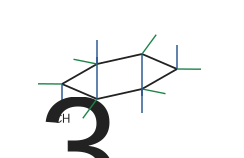
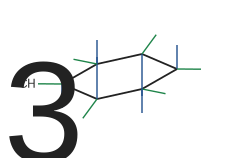
| Group | Axial strain (kJ/mol) | % equatorial at 25 C |
|---|---|---|
| F | 1.0 | 60 |
| Cl | 2.0 | 70 |
| OH | 3.8 | 82 |
| 7.6 | 95 | |
| 8.0 | 96 | |
| 9.2 | 97 | |
| 22.8 | > 99.9 | |
| 13 | 99 |
Worked example: From K to percentages
If for an equatorial/axial equilibrium, what percentage is axial?
Show answer and solution
Fraction axial : 40 % axial, 60 % equatorial.
tert-Butyl locks the ring
A tert-butyl group is so large (22.8 kJ/mol) that it stays equatorial almost 100 % of the time. It "locks" the ring: cis-4-tert-butylcyclohexanol has its OH axial; the trans isomer has its OH equatorial.