Propane and butane
Conformations notes: Propane and butane, explained step by step, with 1 worked example.
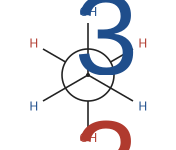
Propane's barrier is 14 kJ/mol: two H/H (2 x 4.0) and one H/ eclipsing (6.0 kJ/mol).
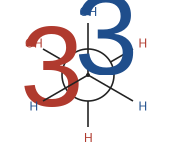
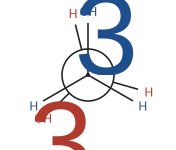
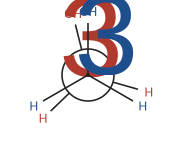
Butane (rotation about C2-C3) has several distinct conformers.
| Interaction | Cause | kJ/mol | kcal/mol |
|---|---|---|---|
| H/H eclipsed | torsional strain | 4.0 | 1.0 |
| H/ eclipsed | mostly torsional | 6.0 | 1.4 |
| / eclipsed | torsional + steric | 11 | 2.6 |
| / gauche | steric | 3.8 | 0.9 |
anti < gauche < eclipsed (/H) < fully eclipsed (/). The gauche form has no eclipsing, only steric strain: the two methyl groups are 60 apart and their H atoms crowd each other.
If the two groups can H-bond (ethylene glycol, 2-fluoroethanol, 2-aminoethanol) or show a gauche effect (1,2-difluoroethane), the gauche conformer is the more stable one.
In a Newman projection of 1,2-dichloropropane viewed along C1-C2, the front carbon (C2) carries Cl, H and X; the back carbon (C1) carries Cl, H and Y. Which pairs (X, Y) are possible? (A) Cl, H (B) Cl, (C) , Cl (D) H,
Show answer and solution
(B) and (D). C2 of 1,2-dichloropropane carries Cl, H, and C1; C1 carries Cl, H, H and C2. The projection must show the right three groups on each carbon in some view along the C1-C2 bond. Check each option against these lists.