Basic strength
Acidic and Basic Strength notes: Basic strength, explained step by step, with 3 worked examples.
A base is stronger when its lone pair is more available and when its conjugate acid () is more stable. In water we compare the of the conjugate acid (): higher = stronger base.
- Hybridisation: N (amines, about 10-11) > N (pyridine, 5.2) > N (nitriles, about -10).
- Resonance: a delocalised lone pair is less basic. Aniline ( 4.6) << cyclohexylamine (10.6). Amides are hardly basic (about -0.5) and protonate on O.
- Induction: donors increase, acceptors decrease basicity. ( 5.7) is far weaker than (10.7). The effect fades with distance.
- Aromaticity: pyrrole's N lone pair is part of the aromatic sextet, so pyrrole is almost non-basic ( about -3.8); pyridine's is not.
- Solvation and sterics (see below).
| Base | Reason | |
|---|---|---|
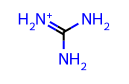
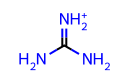
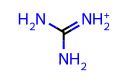
| guanidine | 13.6 | the cation has three equal resonance forms |
| DBU-type amidines | 12-13 | resonance-stabilised cation |
| 10.7 | two +I groups, good solvation | |
| 10.6 | | ||
| 9.8 | poor solvation of | |
| 9.25 | | ||
| pyridine | 5.2 | lone pair |
| aniline | 4.6 | lone pair delocalised |
| p-nitroaniline | 1.0 | -M of |
| pyrrole | -3.8 | lone pair in the aromatic sextet |
In the gas phase (no solvent): (inductive order). In water: . The ion has only one N-H to H-bond with water, so it is poorly solvated. For ethylamines in water: .
Special cases
- Quinuclidine vs triethylamine: quinuclidine is more basic. Its alkyl groups are tied back, so the lone pair is unhindered and the cation is well solvated.
- Bredt's rule: in a bicyclic lactam or aniline where the N is at a bridgehead, the N lone pair cannot overlap with C=O or the ring (that would need a bridgehead double bond). The N stays basic, like an ordinary amine.
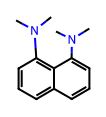
- Proton sponge (1,8-bis(dimethylamino)naphthalene, 12.1): two crowded N lone pairs repel each other; protonation relieves this strain and the H is held between both N atoms.
- Imines ( N) are weaker bases than amines; amidines and guanidines are stronger, because their cations are resonance stabilised.

Rank: (a) cyclohexylamine (b) aniline (c) p-methoxyaniline (d) p-nitroaniline (e) pyridine.
Show answer and solution
a (10.6) > c (5.3) > e (5.2) > b (4.6) > d (1.0). p-OMe pushes density into the ring (+M), making the N lone pair a little more available than in aniline; p- pulls it away. (c and e are very close.)
Does each reaction go far to the right? (a) (b) (c) (d)
Show answer and solution
Compare the of the acid on each side; equilibrium favours the weaker acid. (a) No: PhOH (10) is weaker than (6.4). (b) Yes: PhCOOH (4.2) is stronger. (c) Yes: (25) is stronger than (36). (d) No: (25) is weaker than (15.7).
Rank: (a) (b) (c) (d) PhOH (e) (f) .
Show answer and solution
b (2.9) > a (4.8) > d (10) > f (15.7) > c (16) > e (25).
- Compare acids by the stability of their conjugate bases (ARIO); compare bases by lone-pair availability and stability of .
- test: only acids stronger than ( 6.4) give .
- Ortho effect: o-substituted benzoic acids are stronger than benzoic acid.
- Amine basicity in water: 2 > 1 > 3 > (methyl series).
- Guanidine is the strongest neutral nitrogen base; pyrrole and amides are barely basic.