Judging acid strength: look at the conjugate base
Acidic and Basic Strength notes: Judging acid strength: look at the conjugate base, explained step by step, with 1 worked example.
The more stable is, the stronger HA is. Ask four questions, in this order (ARIO).
- Atom: which atom carries the negative charge?
- Resonance: is the charge delocalised?
- Induction: do nearby groups pull or push electron density?
- Orbital: in what kind of orbital (, , ) is the charge?
Then check special effects: steric effects (including steric inhibition of resonance), H-bonding, aromaticity, solvation.
Factor 1: the atom
- Across a row: electronegativity rules. ( about 50) < (36) < (15.7) < HF (3.2).
- Down a group: size rules. A big atom spreads the charge over a large volume. HF (3.2) < HCl (-7) < HBr (-9) < HI (-10). Also (15.7) < (7.0); ROH < RSH.
The row effect is larger than the column effect.
In , compare the O-H and N-H protons.
Show answer and solution
O-H. Removing it puts the charge on O; removing N-H puts it on N. O is more electronegative, so is more stable than .
Factor 2: resonance
A delocalised charge is more stable than a localised one.
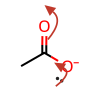

| Acid | (about) | Conjugate base |
|---|---|---|
| (sulfonic acid) | -1 | charge over 3 O |
| 5 | charge over 2 O | |
| 10 | charge over O and 3 ring C | |
| 15 to 16 | localised on O |
These oxygen acids fall in steps of about 5 units: easy to remember.
- Phenol ( 10) is far more acidic than cyclohexanol (16).
- Anilinium ion (4.6) is far more acidic than cyclohexylammonium ion (10.6): in aniline the lone pair is delocalised, so aniline holds a proton less tightly.
- Benzoic acid (4.2) is more acidic than phenol (10).
Factor 3: induction
Electron-withdrawing groups stabilise the conjugate base and strengthen the acid; electron donors do the opposite.
| Acid | Note | |
|---|---|---|
| 4.76 | reference | |
| 4.87 | +I of weakens | |
| 3.18 | -I | |
| 2.90 | -I | |
| 2.86 | -I | |
| 2.59 | strongest -I of the halogens | |
| 1.29 | effects add up | |
| 0.65 | | ||
| 0.23 | | ||
| 1.8 | charged group, strong -I |
2-chlorobutanoic acid ( 2.86) > 3-chloro (4.05) > 4-chloro (4.52) > butanoic acid (4.82). The -I effect fades quickly with each extra bond. Likewise oxalic (1.23) > malonic (2.83) > succinic (4.19) for the first ionisation.
Induction also works for alcohols: (16) > (12.4) > (5.4) in , so the fluorinated alcohols are far stronger acids.
is a slightly weaker acid than . The difference is tiny but is a common exam point.
Factor 4: orbital (hybridisation)
More s character holds a lone pair closer to the nucleus and stabilises it.
HCN ( 9.2) is much more acidic still: its carbanion is on an carbon and is next to electronegative N.
Compare ( 25) with (36). Factor 1 favours N, but factor 4 favours the carbon. Here the orbital effect wins: acetylene is the stronger acid, so deprotonates terminal alkynes.
Usually atom > resonance > induction > orbital. Exceptions exist (above), so check real values when the factors pull in opposite directions.