Which contributor is more important?
Resonance notes: Which contributor is more important?, explained step by step, with 2 worked examples.
- More covalent bonds / complete octets. A structure in which every second-row atom has an octet beats one with an electron-deficient atom.
- Less charge separation. Neutral structures beat charge-separated ones.
- Negative charge on the more electronegative atom, positive charge on the less electronegative atom. beats .
- Like charges far apart, opposite charges close together. Like charges on adjacent atoms make a contributor very poor.
- Equivalent contributors contribute equally, and give the largest resonance stabilisation.
In the methoxymethyl cation the contributor (positive O, all octets) is more important than (positive C, only six electrons on C), even though O is more electronegative. Rule 1 comes before rule 3.
The more stable a contributor is on its own, the larger its share in the hybrid. For the 1,1-dimethylallyl cation, the 3 cation contributor outweighs the 1 one, so the terminal carbon next to the methyl groups carries more of the positive charge, and the bond nearer the end has more double-bond character.
Rank the three contributors of the amide : (I) , (II) , (III) .
Show answer and solution
I > II > III. I is neutral with all octets. II has full octets but separated charges (still important: it explains the planar amide, the short C-N bond and restricted rotation). III has an electron-deficient carbon and separated charges.
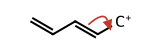
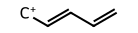
In the cation , where is the positive charge found?
Show answer and solution
Push the bonds towards the cation one at a time: the charge appears on C1, C3 and C5 (alternate carbons). So C1, C3 and C5 share the positive charge; C2 and C4 carry none.