Topic 4 of 4
Special secondary suffixes (-carbaldehyde, -carboxylic acid, -carbonitrile)
Nomenclature of Polyfunctional Compounds notes: Special secondary suffixes (-carbaldehyde, -carboxylic acid, -carbonitrile), explained step by step, with 1 worked example.
When to use them
Use the "-carb..." form when the carbon of the group cannot be part of the parent:
- The group is attached to a ring (cyclohexanecarboxylic acid, benzaldehyde = benzenecarbaldehyde).
- Three or more identical principal groups sit on carbons that cannot all be in one unbranched chain. Then the chain carries all of them as -carb... suffixes and their carbons are not counted in the chain.
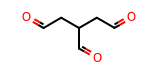
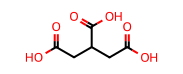
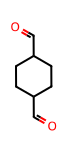
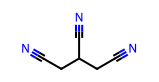
Ketones never use a "-carb" form
The ketone carbon is always in the parent chain or ring, so the rule above does not apply to -one.
Common traps
- With two COOH on the ends of a chain, the chain includes both carbons: HOOC--COOH is propanedioic acid, not methanedicarboxylic acid.
- An ester as the principal group: name the alkyl of the alcohol part first: = methyl 3-hydroxypropanoate.
- When an acid and an ester are both present, the acid wins and the ester becomes alkoxycarbonyl: = 3-methoxy-3-oxopropanoic acid (also called 2-(methoxycarbonyl)acetic acid).
Worked example: Principal group decides numbering
Name .
Show answer and solution
OH (alcohol) is senior to (amine), so the suffix is -ol. The parent is a 5-carbon chain: with one methyl branch.
- From the amine end: on C1, OH on C3, on C4.
- From the other end: on C2, OH on C3, on C5.
OH gets C3 either way, so compare the prefix locants: {1,4} beats {2,5}. Name: 1-amino-4-methylpentan-3-ol.