Resonance questions: Unsolved examples
11 questions, each with the answer and a worked solution under it. Try each one before you open the answer.
Which pairs represent resonance forms, and which do not? Explain.
Show answer and solution
only (a): just the electrons and the charge move. In (b) the end groups change between and , so H atoms have moved: different compounds.
Cyclobuta-1,3-diene is a rectangular molecule with two short double bonds and two long single bonds. Why are its two "Kekule" structures (double bonds horizontal vs vertical) not resonance forms?
Show answer and solution
in a rectangle the two structures put the short bonds in different places, so the nuclei would have to move; they are two distinct (rapidly interconverting) geometries, not contributors. Delocalisation in the square form is unfavourable (antiaromatic, chapter 20).
Which pairs represent resonance structures? (a) and (b) and (c) and (d) below.


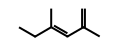
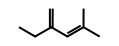
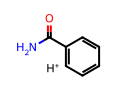
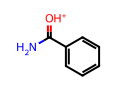


Show answer and solution
(a) and (d). In (b) and (c) an H has moved (different species).
U4: Naphthalene has three resonance forms. Draw them. U5: Are the following pairs resonance contributors or different compounds? (b) and (c) and (e) and ; (a) and (d) below.


Show answer and solution
U4: the three Kekule structures; the C1-C2 bond is double in two of them.
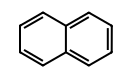
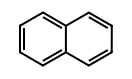
U5: (a) different compounds (an H has moved) (b) resonance forms (c) different (keto/enol tautomers) (d) resonance forms (the allylic cation; only the pair and the charge move) (e) different (an H moves).
Write the contributors and the hybrid of (a) (b) diazomethane, .
Show answer and solution
(a) B has only six electrons. A Cl lone pair can form a partial B=Cl bond: three equivalent forms plus the neutral form. Hybrid: each B-Cl has slight double-bond character. (b) , (and a minor form with a sextet on N).


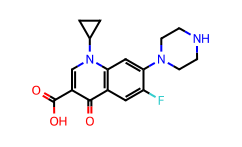
Circle the conjugated atoms of ciprofloxacin.
Show answer and solution
the whole quinolone core: both rings, the C=O, the COOH carbon and its two O atoms, the ring N (its lone pair), the F and the piperazine N attached to the ring (their lone pairs), and the cyclopropyl-bearing N. The cyclopropyl carbons and the other piperazine atoms are not conjugated.
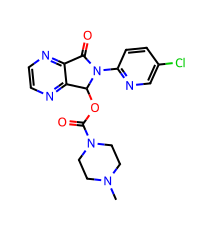
How many atoms are conjugated in the drug below (zopiclone)?
Show answer and solution
20 atoms: the pyrazine and pyrrolinone rings with their C=O, the amide N, the chloropyridine ring, the carbamate O and C=O and the piperazine N bonded to it. The CH and the rest of the piperazine are not counted.
Four structures for HCNO:
- AH-C(:)=N=O
- BH-CN-O with three lone pairs on O
- CH-CN=O
- DH-C=N-O with a lone pair on N. Which have: (a) a C(+) (b) an N(+) (c) an O(+) (d) a C(-) (e) an N(-) (f) an O(-)? (g) Which are neutral overall? (h) most stable? (i) least stable?
Show answer and solution
(a) D (b) A, B (c) none (d) A (e) none (f) B, D (g) A, B, D (each has equal + and - charges) (h) B: all octets, negative charge on O (, fulminic acid) (i) C: N would have 10 electrons.
Which resonance contributor makes the greater contribution to the hybrid? (a) or (e) or (i) or (j) buta-1,3-diene or ; (b), (c), (d), (f), (g), (h) below (first vs second).


Show answer and solution
Answer key: (a) first (2 cation) (b) second (3) (c) second (no charge) (d) first (neutral phenol) (e) second (charge on O) (f) equal (g) second (oxonium, all octets) (h) second (all octets) (i) second (iminium, all octets) (j) first (no charge separation).
U11: Draw the most stable resonance structure of each:

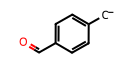


U12: Are benzocyclobutene and o-xylylene resonance forms of one another?


Show answer and solution

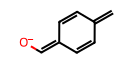
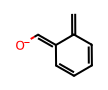

U12: no. The C-C bond of the four-membered ring is present in one and absent in the other; they are different compounds (valence isomers).
Draw the other structures of the nitrate ion.
Show answer and solution
Three equivalent structures; each N-O bond has order and each O carries .


