Resonance questions: Exercise: single choice
34 questions, each with the answer and a worked solution under it. Try each one before you open the answer.
Number of resonance structures of: Q1 the cyclooctatetraene dication (drawn with two + charges), Q2 the cation below, Q3 the 1-naphthoxide ion.

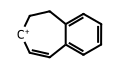
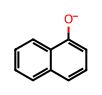
Q1: (A) 0 (B) 14 (C) 16 (D) 18. Q2: (A) 7 (B) 8 (C) 9 (D) 10. Q3: (A) 7 (B) 8 (C) 9 (D) 10.
Show answer and solution
Q1 (C) 16. Six electrons are spread over eight carbons. A contributor puts three C=C bonds on the ring with no two sharing an atom; the number of ways to choose 3 such bonds on an 8-membered ring is . Q2 Answer key (A) 7. Q3 Answer key (D) 10. (Counts like Q2 and Q3 depend on whether every Kekule variant is counted separately; follow the original question's convention of counting them.)
Dewar benzene (bicyclo[2.2.0]hexa-2,5-diene) is related to benzene as:

- Aa resonance structure
- Ban enantiomer
- Cno relation
- Da structural isomer
Show answer and solution
(D). Same formula , different connectivity (it has a C-C bond across the ring), so it is a real, separate compound.
The three MOs of the allyl anion are drawn as: (1) three p orbitals with alternating phases, (2) two p orbitals with a node (dot) on the central carbon, (3) three p orbitals all in phase. Which labels are correct, in this order?
- ALUMO, HOMO, bonding
- BLUMO, bonding, HOMO
- Cbonding, LUMO, HOMO
- Dbonding, HOMO, LUMO
- EHOMO, bonding, LUMO
Show answer and solution
(A). (all in phase) is bonding, (node on the central C) is non-bonding and holds the anion's highest pair (HOMO), (two nodes) is the LUMO.
When benzene is protonated, the ion formed is the cyclohexadienyl cation. Which MO is the best picture of the LUMO of this cation?


Options (p orbitals drawn on the five carbons C1 to C5; C6 is the ):
- Aall five lobes in phase (no node)
- Bone node in the middle of the pentadienyl unit
- Ctwo nodes
- Dfour nodes, phase alternating on every carbon
- Elobes only on C1, C3 and C5, with C2 and C4 as nodes and the C1 and C5 lobes opposite in phase to C3.
Show answer and solution
(E). A pentadienyl unit has five MOs. The cation has 4 electrons, which fill and . The LUMO is , the non-bonding MO, with coefficients only on C1, C3 and C5 (the carbons that carry the + charge) and nodes at C2 and C4.
Arrange in order of increasing resonance stabilisation of C=O: (i) (ii) (iii)
- Ai < ii < iii
- Bi < iii < ii
- Cii < i < iii
- Dii < iii < i
- Eiii < ii < i
Show answer and solution
(A). The ester O lone pair donates into C=O; the ketone has two alkyl groups (hyperconjugation and +I) against one in the aldehyde.
Which of the following pairs are resonance contributors?


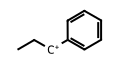
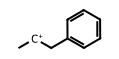
- A and
- Band
- Cbelow
- Dall of the above.
Show answer and solution
(A): only electrons and the charge move. In (B) the two ions have different numbers of H atoms (different formulas); in (C) an H atom has moved.
Which of the following are NOT resonance structures of each other?
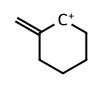
- A and
- Bthe two Kekule forms of benzene
- Cthe pair below
- D and
Show answer and solution
(A): keto and enol differ in where an H sits; they are tautomers, not resonance forms. (B), (C), (D) move only electrons.
Which of the following is NOT a pair of resonance structures?
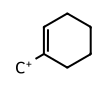
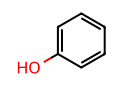
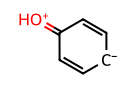
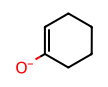
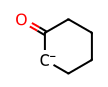
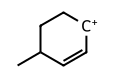
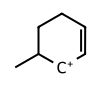


Show answer and solution
(D): 3,4-dihydro-2H-pyran and cyclohexanone have different atoms in the ring; they are different compounds (not even isomers). (A), (B), (C) are true resonance pairs.
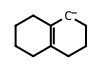
Which is NOT resonance stabilised?


Show answer and solution
(C). Delocalising its charge onto O would need a C=C at the bridgehead of a small bicyclic ring (Bredt's rule), so the carbanion cannot overlap with the C=O system. (A) O lone pair to C=O, (B) enolate, (D) allylic anion are all stabilised.
Most stable canonical structure?


- AI
- BII
- CIII
- Dall equal
Show answer and solution
(C). III has one more bond (8 vs 7) and every atom has an octet. Order: III > I = II.
Which is NOT an example of resonance? (I) and (II) a (cyclopentenyl)methyl cation and its methylenecyclopentyl cation form (III) the 2-methylcyclohexyl cation and the cyclohexylmethyl cation (IV) and
- AI
- BII
- CIII
- DIV
Show answer and solution
(C). Going from the 2-methylcyclohexyl cation to the cyclohexylmethyl cation needs an H atom to move: these are different ions.
Which is NOT a proper resonance structure of buta-1,3-diene?
- A
- B
- C
- D
Show answer and solution
(B). The diradical has two unpaired electrons; butadiene has none. All contributors must have the same number of unpaired electrons.
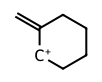
Which pairs are resonance structures? (I) the two Kekule forms of o-xylene (II) acetone and its enol (III) butadiene and its 1,4-diradical (IV) the allylic cation pair below.
- AI, II, III
- BI, IV
- CII, III
- DI, III, IV
Show answer and solution
(B). II needs an H to move (tautomers). III changes the number of unpaired electrons.
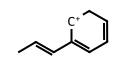
Total number of resonance structures:
- A2
- B3
- C4
- D5
Show answer and solution
(C) 4. The positive charge is delocalised over the cross-conjugated triene: it appears on four carbons (the ring carbon drawn, two more ring carbons, and the side-chain carbon).
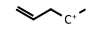
Which carbocation is NOT resonance stabilised?


Show answer and solution
(D). Its C=C is one carbon away (homoallylic), so no overlap. (A) dienyl cation, (B) allylic, (C) O lone pair next to C+.
How many of these are resonance stabilised?


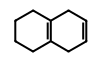
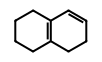


- A7
- B8
- C9
- D10
Show answer and solution
(C) 9. Only (5) is not: its two C=C bonds are separated by carbons. (The original question counts (3) as stabilised; it is a cyclobutenyl-type dication, an unusual species, but its charges are conjugated with the C=C.)
X = resonance structures contributing to the hybrid of aniline; Y = the same for the anilinium ion, . X + Y = ?
- A5
- B6
- C7
- D8
Show answer and solution
(C) 7. Aniline: 2 Kekule + 3 charge-separated (ortho, para, ortho) = 5. Anilinium: N has no lone pair, so only the 2 Kekule forms. 5 + 2 = 7.
Which is NOT resonance stabilised?

Show answer and solution
(C). Bridgehead carbanion next to C=O: forming the enolate C=C at the bridgehead breaks Bredt's rule.
Which has no conjugated multiple bonds?
- Apenta-1,2,4-triene
- Bcyclobuta-1,3-diene
- Chexa-1,5-diene
- D3-methylhexa-2,4-diene
Show answer and solution
(C). Its two C=C are separated by two groups. (A) contains a C=C-C=C unit.
Number of C atoms over which the + charge is delocalised in the resonance hybrid of the cation below.
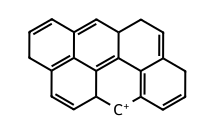
- A5
- B6
- C7
- D8
Show answer and solution
(B) 6. Push each C=C next to a cationic carbon toward it and mark where the + lands: the starting , then the two ring carbons reached through the right-hand C=C units, then three carbons of the left-hand diene path. The carbons (the ring-junction CH next to and the groups) stop the flow. Total 6.
How many of these are ortho/para directing on a benzene ring? (a) -N=O (b) (c) (d) (e) -S(=O)R (f) -COOH (g) -Cl (h) -OH (i)
- A5
- B6
- C7
- D8
Show answer and solution
Answer key: (B) 6 (a, c, e, g, h, i). Nitroso, methyl, Cl and OH are clear o/p directors (nitroso and Cl deactivate). Note: the cases of -S(O)R and are weak and less clear-cut; most textbooks list them with care. , , COOH are meta.
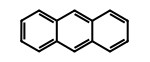
resonance structures of anthracene:
- A6
- B5
- C4
- D2.
Show answer and solution
(C) 4 Kekule structures.
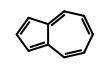
uncharged resonance structures of azulene:
- A1
- B2
- C3
- D4.
Show answer and solution
(B) 2.
correct hybrid of buta-1,3-diene:
- Apartial double bonds at both ends only
- Bpartial double bond character in all three C-C bonds
- Cpartial double bonds at C2-C3 only
- Dnone
Show answer and solution
(B): the end bonds keep most double-bond character and the central bond gains a little.
X = resonance structures of ; Y = resonance structures of . X + Y = ?
- A5
- B6
- C7
- D8
Show answer and solution
Answer key: (C) 7 (X = 2, Y = 5). The original question lets the P atom accept ring density into empty d orbitals. Note: modern bonding theory gives d orbitals almost no role; the "Y = 5" count is a convention used in exam texts, not a proven bonding picture.
number of resonance structures of (tub-shaped) cyclooctatetraene:
- A0
- B2
- C4
- D8.
Show answer and solution
(A) 0. COT is tub shaped; its double bonds are localised and do not overlap, so it has no resonance (its two "Kekule-like" forms are separate bond-shift isomers).
number of resonance structures of the sulfate ion drawn with two S=O:
- A7
- B6
- C9
- D8
Show answer and solution
(B) 6: choose which two of the four O carry the double bonds: .
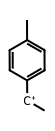
in the 1-(4-methylphenyl)ethyl cation, how many resonance structures have the charge on a 2 carbon?
- A2
- B3
- C4
- D5.
Show answer and solution
(C) 4: the exocyclic secondary cation (drawn with two Kekule forms) plus the two ortho ring carbons; the para ring carbon carries the methyl and is tertiary.
x, y, z = numbers of resonance structures of phenoxide, phenol and ; x + y + z = ?
- A12
- B13
- C10
- D11.
Show answer and solution
(A) 12: 5 + 5 + 2.
number of resonance structures of anthracene:
- A3
- B4
- C5
- D6.
Show answer and solution
(B) 4.
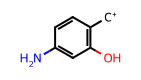
number of resonance structures of the cation below:
- A5
- B6
- C7
- D8
Show answer and solution
Answer key (C) 7: the charge visits the ortho and para ring carbons, and the para and ortho OH lone pairs each give one more form.
which pair is NOT a resonance pair? (I) allyl cation pair (II) allyl radical pair (III) (cyclopentenyl)methyl cation pair (IV) cyclopentylmethyl cation and cyclopentyl cation (E) all are.
Show answer and solution
(D) (IV): an H must move.
which pair is NOT a pair of resonance forms?
- Abenzocyclobutene and o-xylylene
- Bcyclohexanone enolate and its carbanion
- Cphenoxide and its ortho carbanion form
- Dphenoxide and its para carbanion form.
Show answer and solution
(A): atoms change their connections.
which contributor of anisole's (methoxybenzene) hybrid contributes most when the ring is attacked at para? (A)-(C) carbocations on ring carbons (D) the oxonium form with C=O+-CH3.
Show answer and solution
(D): the oxonium form has the most bonds and all octets.