Optical Isomerism (Stereochemistry) questions: Special problems
48 questions, each with the answer and a worked solution under it. Try each one before you open the answer.
Number of stereocentres in cis-but-2-ene:
- A0
- B1
- C2
- D3.
Show answer and solution
(C) 2: both alkene carbons are stereocentres in the broad sense (swapping H and on either one gives the trans isomer); there is no chiral carbon.
Minimum number of carbons an ester needs to show optical isomerism:
- A4
- B5
- C6
- D7.
Show answer and solution
(B) 5: sec-butyl formate, .
Number of stereocentres in open-chain D-glucose:
- A1
- B5
- C4
- D7.
Show answer and solution
(C) 4 (C2 to C5).
Number of chiral centres in alpha-D-glucopyranose:
- A4
- B5
- C6
- D7.
Show answer and solution
(B) 5 (C1 to C5; C1 becomes a new centre on ring closure).
Number of enantiomers of butan-2-ol:
- A0
- B1
- C2
- D3
Show answer and solution
(C) 2.
Number of diastereomers of gammaxene (1,2,3,4,5,6-hexachlorocyclohexane):
- A6
- B8
- C16
- D24.
Show answer and solution
(B) 8 (one of them is chiral, so 9 stereoisomers).
Number of diastereomers of 3-methyl-5-propylcyclohexene:
- A2
- B4
- C6
- D3.
Show answer and solution
(A) 2 (cis and trans; each is a pair of enantiomers).
Minimum number of carbons a cycloalkane needs to show optical isomerism:
- A4
- B5
- C6
- D7.
Show answer and solution
(B) 5: trans-1,2-dimethylcyclopropane.
Which is true for the allene below?
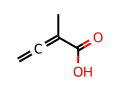
- Ashows optical isomerism
- Bshows geometrical isomerism
- Chas no plane or centre of symmetry
- Dnone of these
Show answer and solution
(D): the terminal carbon carries two H, so there is no axial chirality and no E/Z; the plane of is a plane of symmetry.
Number of chiral centres in beta-D-glucofuranose:
- A4
- B5
- C6
- D7.
Show answer and solution
(B) 5 (C1 to C5; C5 is outside the furanose ring but still chiral).
Number of diastereomers of 2-cyclohexylpent-2-ene:
- A0
- B1
- C2
- D3.
Show answer and solution
(C) 2 (E and Z; no chiral carbon).
Number of diastereomer pairs of tartaric acid:
- A1
- B2
- C3
- D0.
Show answer and solution
(B) 2: meso with (R,R) and meso with (S,S).
D,L configurations of the two structures are:
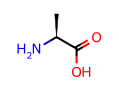
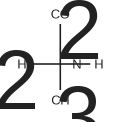
- AD,D
- BL,L
- CD,L
- DL,D
Show answer and solution
(B) L,L: both are (S)-alanine.
Which has a plane of symmetry and a perpendicular n-fold axis?

- As-trans glyoxal, OHC-CHO
- B2-chlorobutane
- Cs-cis-buta-1,3-diene
- Dlactic acid.
Show answer and solution
(A): planar s-trans glyoxal () has the molecular plane and a axis perpendicular to it.
Number of planes of symmetry in cubane with two identical substituents at opposite corners:
- A1
- B3
- C6
- D9.
Show answer and solution
(B) 3 (, three vertical planes through the substituent axis).
The octasubstituted cyclooctane below (Br and alternating round the ring, each pair alternating up and down) has which symmetry element?
- A
- B
- Cplane
- D.
Show answer and solution
(B) .
Total stereoisomers of the compound below:
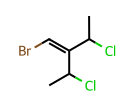
- A2
- B4
- C6
- D8
Show answer and solution
(B) 4: (R,R) and (S,S) give a pair with a non-stereogenic C=C; for (R,S) the =CHBr can lie toward either arm, giving two forms that are mirror images of each other.
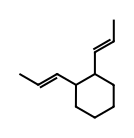
Total stereoisomers of 1,2-di(prop-1-enyl)cyclohexane:
- A8
- B16
- C10
- D32.
Show answer and solution
(C) 10: EE gives cis (meso) + trans pair = 3; ZZ also 3; EZ gives 4 (no symmetry).
a and b are the numbers of diastereomers of cis- and trans-1,2-dimethylcyclobutane, respectively:


- A1,1
- B1,2
- C2,1
- D2,2.
Show answer and solution
(C) 2,1: cis has the trans pair (2) as diastereomers; trans has only the cis (meso) form (1).
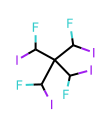
Number of meso isomers of :
- A5
- B2
- C0
- D1.
Show answer and solution
(D) 1: RRRR/SSSS and RRRS/SSSR are chiral pairs; RRSS is the single meso form. Total 5.
Which axis of symmetry is present in trans-but-2-ene?
- A
- B
- C
- D.
Show answer and solution
(A) .
Which of the following is chiral?
- Aa flask
- Ba chair
- Ca person (the original question names a film actor)
- Da original
Show answer and solution
(C): a human body is not superimposable on its mirror image.
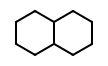
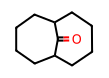
Number of stereoisomers of: Q23 bicyclo[2.2.0]hexane with both bridgehead H shown up (A) 1 (B) 2 (C) 3 (D) 4. Q24 decalin (A) 1 (B) 2 (C) 3 (D) 4. Q25 bicyclo[3.2.0]heptane (A) 1 (B) 2 (C) 3 (D) 4. Q26 the bridged bicyclic ketone below (A) 1 (B) 2 (C) 3 (D) 4. Q27 Number of carbon atoms that lie in one plane in 1-methylcyclohexene: (A) 3 (B) 4 (C) 5 (D) 7



Show answer and solution
Q23 (A) 1: only the cis junction is possible for two fused four-membered rings, and it has a mirror plane. Q24 (B) 2: cis and trans decalin, both achiral. Q25 (C) 3: cis (achiral, mirror plane) + trans (chiral pair). The trans form is very strained. Q26 (C) 3: the two bridgeheads give one achiral form plus one chiral pair. Q27 (C) 5: C1, C2, C3, C6 and the methyl carbon lie in the plane of the C=C.
Which observation proves that carbon is tetrahedral?
- Amethyl bromide has no constitutional isomers
- Btetrachloromethane has no dipole moment
- Cdibromomethane has no constitutional isomers
- Dnone of these.
Show answer and solution
(C): a square-planar carbon would give two forms of (cis and trans); only one is known.
What happens when the biphenyl-2,2'-disulfonic acid below is heated?
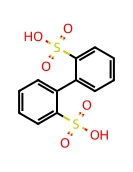
- Aracemic mixture
- Bdiastereomers
- C100% pure enantiomer
- Dno change.
Show answer and solution
(A): with only two ortho groups the rings can rotate past each other at high temperature, so the optically active form racemises.
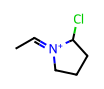
Number of stereocentres in the iminium ion below:
- A0
- B1
- C2
- D3.
Show answer and solution
(D) 3: the C=N carbon and N (E/Z about C=N, the two ring arms of N differ because of the Cl) and the CHCl carbon.
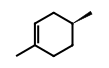
An optically active (A) gives an optically inactive product on catalytic hydrogenation. Which can be A? (A) cis-3,6-dimethylcyclohexene (B) trans-3,6-dimethylcyclohexene (C) 1,4-dimethylcyclohexene (D) B and C
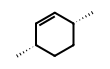
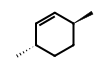
Show answer and solution
(D): (A) is meso and inactive to start with. (B) is chiral and gives trans-1,4-dimethylcyclohexane (achiral). (C) is chiral at C4 and gives 1,4-dimethylcyclohexane (achiral).
Which can be resolved?
- Acis-1,3-dimethylcyclohexane
- B1,1-dimethylcyclohexane
- Ccis-1,4-dimethylcyclohexane
- Dcis-1-ethyl-3-methylcyclohexane.
Show answer and solution
(D): the only chiral one; (A) and (C) are meso/achiral, (B) has no stereocentre.
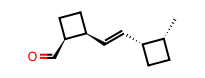
The compound below is treated with then Zn. Number of chiral products:
- A0
- B1
- C2
- D3.
Show answer and solution
(B) 1: the left ring gives cis-cyclobutane-1,2-dicarbaldehyde (meso), the right ring gives cis-2-methylcyclobutane-1-carbaldehyde (chiral).
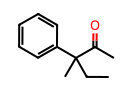
Which is chiral and racemises with a trace of base?
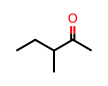
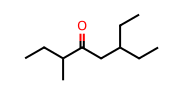
- A3-methylpentan-2-one
- B3-methyl-3-phenylpentan-2-one
- Cthe diketone shown, 3,6-diethyloctan-4-one
- Dall of these.
Show answer and solution
Answer key (D). Checked: (A) and (C) racemise, because each has its only stereocentre alpha to C=O with an H that base removes (planar enolate). (B) has no alpha-H at its stereocentre and cannot racemise this way. In (C) the second Et-bearing carbon also carries an ethyl in the chain, so it is not a stereocentre.) does not racemise.
The spiro compound below (dimethyl rings, methyls up on one ring and in the plane of the other) has which axis:
- A
- B
- C
- D
Show answer and solution
(C) .
The cyclobutane below (Ph and COOH on alternate corners, groups alternating up and down) has:
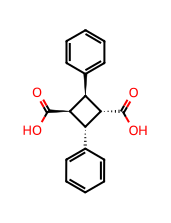
- Amirror symmetry
- Bcentre of inversion
- Cn-fold alternating axis
- Dall of these.
Show answer and solution
(B) centre of inversion. The inversion centre is the same thing as an axis, so (C) is also true in a strict sense; there is no mirror plane.
n = stereocentres, m = stereogenic double bonds. Maximum configurational isomers:
- A
- B
- C
- D.
Show answer and solution
(A) : in this original's counting every stereogenic C=C contributes 2 stereocentres (its two carbons) but only 2 forms, so total = .
Stereoisomers of camphor:

- A1
- B2
- C3
- D4.
Show answer and solution
(B) 2: two stereocentres, but the bridge fixes their relation, so only one pair.
Stereoisomers of twistane:
- A2
- B3
- C4
- D8.
Show answer and solution
(A) 2: twistane is chiral ().
Stereocentres and stereoisomers of the adamantane with Me, COOH, H and Br on the four bridgeheads:
- A2,2
- B2,4
- C4,2
- D4,4
Show answer and solution
(C) 4,2: four bridgehead stereocentres, but the cage fixes them together; only one pair of enantiomers.
Stereoisomers of penta-2,3-diene:

- A2
- B3
- C4
- D6.
Show answer and solution
(A) 2 (axial chirality).
Stereocentres and stereoisomers of cyclooctene:
- A0,1
- B1,1
- C2,3
- D2,4.
Show answer and solution
(C) 2,3: Z (achiral) + E (chiral pair).
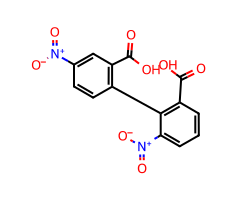
Stereoisomers of the biphenyl below:
- A0
- B1
- C2
- D4.
Show answer and solution
(C) 2: both rings carry two different ortho groups, so rotation is blocked and the molecule is chiral.
Stereoisomers of hexahelicene:
- A0
- B1
- C2
- D4.
Show answer and solution
(C) 2 (P and M helices).
A mixture of all stereoisomers of is fractionally distilled. Number of fractions:
- A5
- B6
- C3
- D4
Show answer and solution
(D) 4: six stereoisomers in all (RR/SS-E, RR/SS-Z, meso-E, meso-Z). Distillation separates diastereomers but not enantiomers, so 4 fractions.
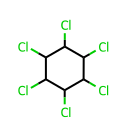
Number of meso isomers of 1,2,3,4,5,6-hexachlorocyclohexane:
- A6
- B9
- C8
- D7.
Show answer and solution
(D) 7 (8 diastereomers, one chiral).
Meso isomers of 1,3-di(butan-2-yl)cyclohexane:
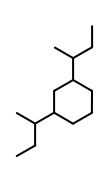
- A1
- B2
- C3
- D4.
Show answer and solution
(B) 2 (checked by enumeration: 10 stereoisomers, 2 meso).
Which statement is NOT true?
- Adiastereomers are stereoisomers that are not mirror images
- Ba pair of enantiomers has the same melting point
- Cdiastereomers do not have equal specific rotations
- Ddiastereomers are superimposable mirror images.
Show answer and solution
(D).
Amount of the major enantiomer in a sample that is 80% optically pure:
- A90%
- B60%
- C70%
- D80%.
Show answer and solution
(A) 90%: ee 80% means 80% excess plus 20% racemate (10% each), so 90: 10.
Number of stereoisomers of the compound (structure not as drawn):
- A2
- B3
- C4
- D5.
Show answer and solution
Key (C) 4; the structure is missing.
Stereoisomers of the cyclopentene below:
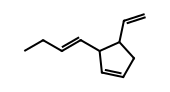
- A8
- B16
- C32
- D64.
Show answer and solution
(A) 8: two ring stereocentres and one E/Z double bond, no symmetry, = 8.
(+)-Tartaric acid has = +12.0. Find the specific rotation of a mixture of 68% (+) and 32% (-).
Show answer and solution
Excess of (+) = 68 - 32 = 36%, so = 0.36 12.0 = +4.32.