Optical Isomerism (Stereochemistry) questions: Unsolved examples
24 questions, each with the answer and a worked solution under it. Try each one before you open the answer.
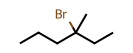
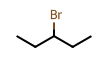
Which of the following compounds has an asymmetric centre?




Show answer and solution
(a), (c), (f). (a) 2-chlorobutane: C2 carries H, Cl, , . (c) 3-bromo-3-methylhexane: C3 carries Br, , ethyl, propyl. (f) but-3-en-2-amine: C2 carries H, , , vinyl. In (b) C2 has two ; in (e) C3 has two ethyls; (d) has no carbon with four different groups.
Which of the following compounds has one or more asymmetric centres?


Show answer and solution
A, C, E. A (3-methylcyclohexene) and C (4-methylcyclohexene): the ring carbon with the methyl has two different ring paths (one reaches the C=C sooner). E (1,2-dimethylcyclohexane) has two stereocentres. In B the two ring paths are the same, and in D the methyl sits on an carbon.
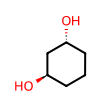
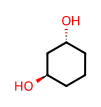
Is each structure A to D an enantiomer of, a diastereomer of, or identical to the reference structure (trans-cyclohexane-1,3-diol)?
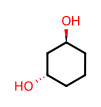
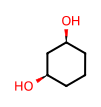
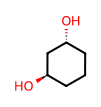
Show answer and solution
A identical, B enantiomer, C diastereomer (cis isomer, meso), D identical. Note: in the printed A the wedge on the left carries no label; it must be read as OH for the original question answer to hold. Trans-1,3-diol is chiral (no mirror plane); cis-1,3-diol has a mirror plane.
Which of the following are optically active?

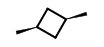

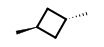
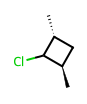
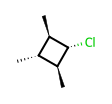

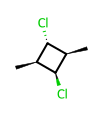
Show answer and solution
Answer key: iii, iv, vi. Checked with 3D models, row by row as printed: (iii), (v), (vii) are chiral. (iii) trans-1,2-dimethylcyclobutane: no mirror plane. (v) 2-chloro-1,3-dimethyl with the methyls trans: only a axis, so chiral. (vii) cis-1-chloro-2-methyl: two different groups, no plane. (i) cis-1,2 is meso; (ii) and (iv) are 1,3-disubstituted cyclobutanes, which always have a plane through C1 and C3; (vi) and (viii) also have a mirror plane. The Answer key probably numbers the drawings differently.
Are the following pairs identical, enantiomers, diastereomers or constitutional isomers?


Show answer and solution
(a) diastereomers (cis vs trans). (b) enantiomers (cis, both groups up vs both down). (c) enantiomers. (d) constitutional isomers (1,3 vs 1,2).
Are the following pairs identical, enantiomers, diastereomers or constitutional isomers?
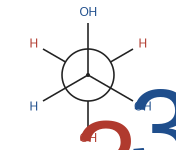
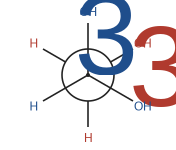
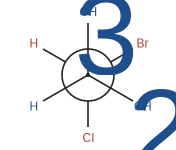
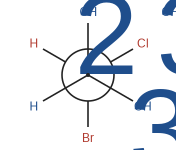
Show answer and solution
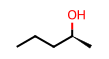
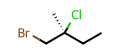
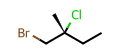
(a) enantiomers (both butan-2-ol; going from one to the other swaps OH and on the front carbon, one swap). (b) Both are 1-bromo-1-chloro-2-methylbutane. In the printed first drawing one back group has no label; read as Br, both carbons are inverted (front: /ethyl swapped, back: Br/Cl swapped), which makes them enantiomers. Answer key: diastereomers.
What is the configuration of the asymmetric centres?
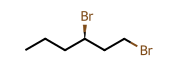
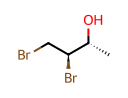
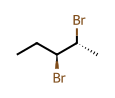
Show answer and solution
(a) R (Br > > propyl > H). (b) Answer key 2R,3S. As printed, the OH carbon shows only OH and H besides C2, so one group is missing; with there it works out as (2R,3R) from the drawing. (c) (2R,3S)-2,3-dibromopentane (checked).
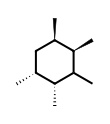
Are the following pairs identical, enantiomers, diastereomers or constitutional isomers?


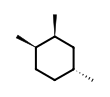
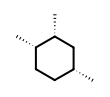
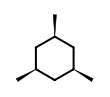
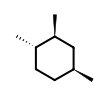
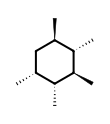
Show answer and solution
Answer key: (a) diastereomers (b) constitutional (c) constitutional (d) diastereomers. Checked from the printed drawings: (a) the first drawing has three methyls and the second only two, so as printed they are not isomers (different formulas). (b) both are 1,2,4-trimethylcyclohexane; the second is the first turned by 120 in the plane, so they are identical, not constitutional isomers. (c) constitutional isomers (1,3,5 vs 1,2,4). (d) diastereomers.) and (b), these look like printing errors.
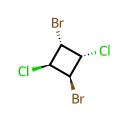
Is this compound (1,3-dibromo-2,4-dichlorocyclobutane, groups alternating up and down) optically active?
Show answer and solution
No. The two Cl are trans across the ring diagonal and so are the two Br. The ring centre is a centre of symmetry (inversion takes Cl-up to Cl-down, Br-down to Br-up), so the molecule is achiral.
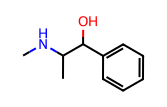
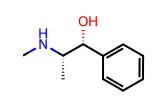
Ephedrine, from the herb ephedra, is used to open the airways in asthma. (a) How many stereoisomers does ephedrine have? (b) For the active stereoisomer shown, give the configuration of each asymmetric centre.
Show answer and solution
(a) Two asymmetric centres (C1 with OH, C2 with ), so = 4 stereoisomers (ephedrine and pseudoephedrine pairs). The Answer key prints "2", which is the number of centres. (b) (1R,2S). At C1: OH > C2 (N) > phenyl > H. At C2: N > C1 (O) > > H.
Which pairs represent the same enantiomer and which represent different enantiomers?


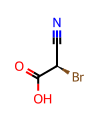
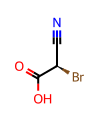


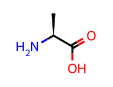
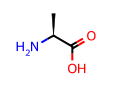
Show answer and solution
(a) different enantiomers. (b), (c), (d) same (identical). Quick test: one swap of two groups inverts; two swaps restore. Pairs (b) to (d) differ by an even number of swaps.
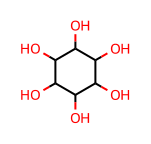
How many diastereomers does inositol (cyclohexane-1,2,3,4,5,6-hexol) have, and how many are meso?
Show answer and solution
Answer key: 9 stereoisomers in total, 7 meso. Count them by moving OH groups one at a time from the top face to the bottom face: 6 up; 5 up/1 down; 4 up with the down pair 1,2 or 1,3 or 1,4; 3 up with the down set 1,2,3 or 1,2,4 or 1,3,5. That is 8 distinct diastereomers. Seven have a mirror plane (meso). Only the 1,2,4-down form (chiro-inositol) is chiral and exists as a pair, so 8 diastereomers give 9 stereoisomers.
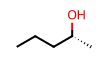
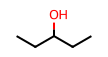
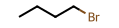
Identify the chiral and achiral molecule in each pair.



Show answer and solution
In each pair (i) is chiral and (ii) is achiral. (I)(i) 1-bromoethanol has H, OH, Br, ; (I)(ii) has two Br on one carbon. (II)(i) pentan-2-ol is chiral; (II)(ii) pentan-3-ol has two ethyls on C3. (III)(i) 2-bromobutane is chiral; (III)(ii) 1-bromobutane has no stereocentre.
Do the following pairs represent identical molecules or enantiomers?


Show answer and solution
All four pairs are enantiomers. For (a) assign each centre: first is R, second is S. Opposite labels at the only stereocentre means mirror images.
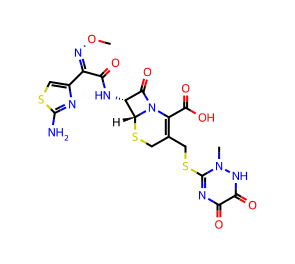
Identify the centres of chirality and give the number of possible optical isomers. (a) ceftriaxone (b) the dihydrofolic acid structure as drawn (c) gramicidin A.
Show answer and solution
(a) 2 chiral centres (C6 and C7 of the four-membered beta-lactam ring), so = 4 optical isomers. The oxime C=N is also stereogenic (the drug is Z), which the original question does not count. (b) Answer key: 3 centres, = 8. This counts the CH carbons of the printed, partly reduced ring drawing. Note that real 7,8-dihydrofolic acid has a glutamate unit with one stereocentre, which the printed drawing omits. (c) No answer key. Gramicidin A has 15 amino-acid units, of which only glycine is achiral, so 14 chiral centres and = 16384 possible isomers. The printed drawing is simplified (it shows phenol rings in place of tryptophan).
If the molecule is pyramidal (C at the apex, four different groups a, b, d, e at the base corners), X stereoisomers are possible for Cabde. Find X.
Show answer and solution
X = 6. The base square can hold the four groups in 3 distinct cyclic orders (fix a; its opposite corner can be b, d or e). A pyramid has no mirror plane when all four base groups differ, so each order exists as a pair of enantiomers: 3 2 = 6.
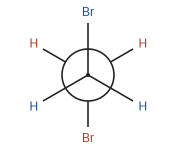
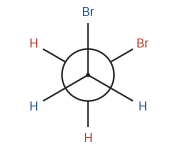
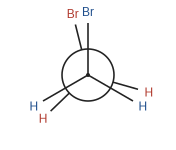
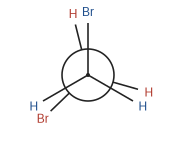
Total number of planes of symmetry in all conformations of 1,2-dibromoethane.
Show answer and solution
3 (anti 1 + gauche 0 + anticlinal 0 + syn eclipsed 2).
Total number of isomers of having a cyclobutane ring.
Show answer and solution
7. Ethylcyclobutane (1), 1,1-dimethyl (1), 1,2-dimethyl (cis meso + trans pair = 3), 1,3-dimethyl (cis + trans, both achiral = 2). Four constitutional isomers, seven when stereoisomers are counted.
(i) Total stereoisomers of 2,3-dichlorobutane = a. (ii) Total stereocentres in = b. Find a + b.
Show answer and solution
a = 3 (R,R; S,S; meso). b = 3 (two stereogenic C=C units and one chiral carbon; 8 stereoisomers). a + b = 6.
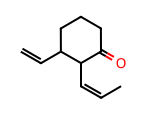
How many stereoisomers of this compound are possible when the alkenyl substituent is cis?
Show answer and solution
4. With the C=C fixed as cis, only the two ring stereocentres (C2 and C3) remain: = 4, no meso form.
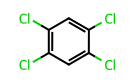
Total number of planes of symmetry in 1,2,4,5-tetrachlorobenzene.
Show answer and solution
3: the ring plane and two planes perpendicular to it (one through the two C-H carbons, one bisecting the C-Cl pairs).
Find the total number of stereocentres in .
Show answer and solution
3: the C=C (stereogenic) and the two carbons bearing Br and Cl. Total stereoisomers = 8.
Find the total number of stereoisomers of .
Show answer and solution
4. EE and ZZ: the central carbon carries two identical arms, so it is not a stereocentre (1 + 1). EZ: the arms differ, the central carbon is chiral, giving a pair (2). Total 4.
Find the total number of isomers of (only five-membered ring).
Show answer and solution
9 constitutional isomers: propyl-, isopropyl-, 1-ethyl-1-methyl-, 1-ethyl-2-methyl-, 1-ethyl-3-methyl-, 1,1,2-, 1,1,3-, 1,2,3- and 1,2,4-trimethylcyclopentane. Counting stereoisomers: 1 + 1 + 1 + 4 + 4 + 2 + 2 + 4 + 4 = 23 (checked by enumeration). No answer key.