Optical Isomerism (Stereochemistry) questions: Symmetry elements
11 questions, each with the answer and a worked solution under it. Try each one before you open the answer.
Which capital letters A to Z have (in their own plane) a vertical mirror line? Which have none?
Show answer and solution
Answer key: one plane in A, B, C, D, E, K, M, T, U, V, W, Y; two or more in H, I, O, X; none in F, G, J, L, N, P, Q, R, S, Z. (Each flat letter also has its own molecular plane.)
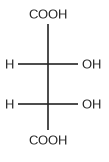
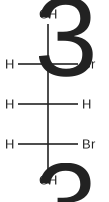
Show the symmetry plane in (a) meso-tartaric acid (Fischer and Newman views) (b) a tetrasubstituted biphenyl with , COOH on one ring and , F on the other (c) cis-but-2-ene (d) trans-but-2-ene (e) meso-2,3,4-trichloropentane (f) meso-2,4-dibromopentane (g) cis- and trans-1-bromo-3-methylcyclobutane.
Show answer and solution
(a) A horizontal plane between C2 and C3 in the eclipsed Fischer form; in the staggered Newman form a centre of symmetry. (b) the plane of one ring when the rings are perpendicular: the substituted biphenyl is achiral if one ring carries two identical ortho groups. (c) both the molecular plane and a plane perpendicular to it. (d) only the molecular plane (and a centre of symmetry). (e) the plane through C3. (f) the plane through C3. (g) in both cyclobutanes a plane through C1, C3 and their substituents: both are achiral.
Which are achiral, which chiral? cis-1,2-dimethylcyclopropane, trans-1,2-dimethylcyclopropane, cis- and trans-1,2-dimethylcyclobutane, 1,3-dimethylcyclobutanes, 1,2-, 1,3- and 1,4-dimethylcyclohexanes, a bicyclic diene with a twisted C=C, and penta-2,3-diene.
Show answer and solution
Achiral: cis-1,2-dimethylcyclopropane, cis-1,2-dimethylcyclobutane, both 1,3-dimethylcyclobutanes, cis-1,2-, cis-1,3- and both 1,4-dimethylcyclohexanes. Chiral: the trans-1,2 compounds (cyclopropane, cyclobutane, cyclohexane), trans-1,3-dimethylcyclohexane, penta-2,3-diene, and the twisted bicyclic alkene (its mirror images do not interconvert).
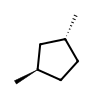
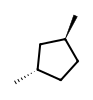
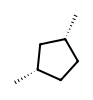
Which 1,3-dimethylcyclopentane is optically active? (A) pure trans, drawn with one wedge and one dash (B) pure trans drawn the other way (C) pure cis (wedge, wedge) (D) pure cis (dash, dash). Options: (A) pure A (B) pure C (C) a 1:1 mixture of A and B (D) pure D.
Show answer and solution
(A). The trans isomers have no plane of symmetry: A and B are enantiomers (a 1:1 mixture is racemic). The cis isomer (C = D) is meso.
Which Newman conformers of 1,2-dibromoethane have a plane of symmetry?
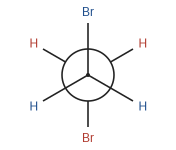
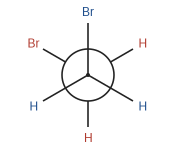
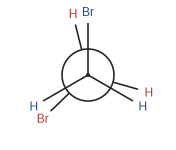
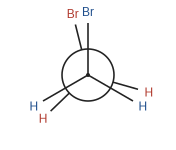
- Aanti
- Bgauche
- Cpartly eclipsed
- Dfully eclipsed
Show answer and solution
(A) and (D). The gauche conformer is chiral (it lacks a plane), but it interconverts with its mirror image by rotation, so 1,2-dibromoethane is not optically active.
Which have a centre of symmetry (i)? Ammonia; benzene; the trans and cis 3,6-dimethylpiperazine-2,5-diones; trans-2,3-dichlorobut-2-ene; ethene.
Show answer and solution
Present: benzene, the trans dimethyldiketopiperazine, trans-, ethene. Absent: ammonia, the cis dimethyldiketopiperazine. A molecule with i is achiral even if it has no mirror plane.
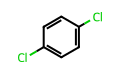
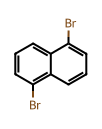
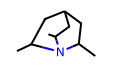
Find the main axis of symmetry (, n = 360/) in each: , , , HCl, , and the compounds below.



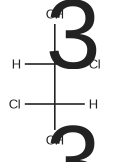
Show answer and solution
; ; water ; HCl ; (main); . p-Dichlorobenzene (the one through the two Cl atoms is preferred, since it passes through more atoms); ; benzene ; cyclopropane ; cyclobutane ; none (no , only the molecular plane); 1,5-dibromonaphthalene (perpendicular to the ring plane); ethene ; the trimethyl cage (through N and the opposite bridgehead C); the Fischer compound (2S,3S)-2,3-dichlorobutane . The original question also shows phenalene (). Rule: when several axes exist, the one with the highest n is the main axis. An axis of symmetry alone does not make a molecule achiral.
Match the column. Column I: Column II: (P) a cage of three stacked cubes (a lattice of atoms) (Q) hexaprismane (R) a -symmetric hexacyclic compound with three methyls (a central six-membered ring fused to six five-membered rings) (S) and (T) as drawn below.

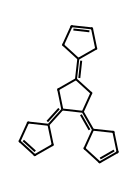
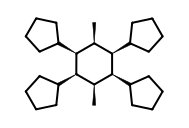
- A axis of symmetry
- B axis of symmetry
- Cplane of symmetry
- Dcentre of symmetry.
Show answer and solution
Answer key: A to P, Q, S, T; B to P, R; C to P, Q, R, S, T; D to P. (Q) hexaprismane: main axis with axes and planes, but its centre of symmetry is not listed. (S) axis and a plane. (T) all-cis: a plane through the two carbons and a axis perpendicular to the ring.
Match
- Aa hexa-annulated -symmetric polycycle
- Bcis-1,2-dichlorocyclohexane
- Cthe all-trans 1,3-dichloro-4,6-dibromocyclohexane drawn with alternating groups
- D(R,R)-2,3-dichlorobutane (Fischer) with (P) centre of symmetry (Q) axis (R) plane of symmetry (S) optically active (T) axis.
Show answer and solution
Answer key: A to P, Q, R, T; B to R; C to P; D to Q, S.
Which objects are chiral? (a) soda can (b) screwdriver (c) screw (d) shoe. Ignoring markings, which are chiral: (I) a shoe (II) a original (III) a pencil (IV) a pair of shoes taken as one object (V) a pair of scissors?
- AI
- BI, V
- CI, IV, V
- DIII, IV, V
Show answer and solution
(c), (d). Second part (B): a pair of shoes has an internal mirror plane.
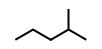
How many compounds shown below are chiral?
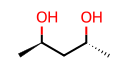


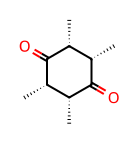
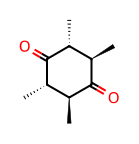
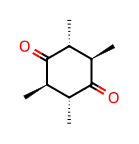
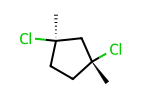
- A4
- B5
- C6
- D8
Show answer and solution
(A) 4: (II), (VI), (IX) and (X). (I) is 2-methylpentane as drawn (the last carbon carries the drawn H, so it is ): no stereocentre. (II) has one OH wedged and one dashed: (R,R) or (S,S), chiral. (III) has a mirror plane through C1 and the C=C midpoint. (IV) cis-1,2 and (V) cis-1,3 are meso. (VI) trans-1,2 is chiral. (VII) and (VIII) have mirror planes. (IX) and (X) have no plane and no centre of symmetry.