Optical Isomerism (Stereochemistry) questions: Meso compounds
5 questions, each with the answer and a worked solution under it. Try each one before you open the answer.
Is the 1,2,3-trimethylcyclohexane drawn with all three methyls on wedges a meso compound? Which of these are meso: (a) a 1,2,4,5-tetramethylcyclohexane with alternating wedges (b) trans-1,2-dibromocyclopentane (c) (2R,3S)-butane-2,3-diol?
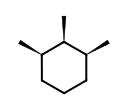
Show answer and solution
The all-cis 1,2,3-trimethylcyclohexane is meso: a plane passes through C2 and its methyl. Of (a)-(c): (a) and (c) are meso; (b) trans-1,2-dibromocyclopentane is chiral.
Find the number of meso forms, enantiomers and diastereomers of 1,2,3,4,5,6-hexachlorocyclohexane (gammexane, ).
Show answer and solution
9 stereoisomers: 7 meso and 1 pair of enantiomers. The meso forms are all-cis, 1-trans, 1,2-trans, 1,3-trans, 1,4-trans, 1,2,3-trans and 1,3,5-trans; the 1,2,4-trans isomer is chiral. There are 8 diastereomers (counting the enantiomer pair as one).
Which are meso?
- Acis-1,2-dimethylcyclohexane
- Btrans-1,4-dimethylcyclohexane
- Ccis-1,3-dimethylcyclohexane
- Da 1,2,3-trichlorocyclopropane with Cl atoms alternating
Show answer and solution
Answer key: (A), (C), (D). (B) is achiral but has no stereocentres (C1 and C4 are not chirality centres), so it is not called meso.
x = number of compounds that have a meso stereoisomer. Find x + 7.
- A2-bromo-3-chlorobutane
- B2,2-dibromopropane
- C2,3-dimethylbutane
- D2,3-dichlorobutane
- E1-bromo-2-methylcyclohexane (F) 3,4-dimethylhexane (G) tartaric acid (H) 1,2-dimethylcyclohexane (I) 1,3-dimethylcyclohexane (J) lactic acid
Show answer and solution
Meso forms exist for (D), (F), (G), (H), (I): x = 5, so x + 7 = 12. A meso form needs at least two stereocentres carrying the same set of groups.
(a) How many asymmetric centres and how many stereocentres does 4-chloropent-2-ene () have? (b) Why is "an achiral compound with stereocentres" a poor definition of meso?
Show answer and solution
(a) 1 asymmetric centre (C4); 3 stereocentres (C4, C2 and C3). (b) cis- or trans-but-2-ene are achiral and contain stereocentres (the alkene carbons), but they are not meso. A meso compound must have chirality centres (asymmetric atoms) and still be achiral.