Optical Isomerism (Stereochemistry) questions: Diastereomers
7 questions, each with the answer and a worked solution under it. Try each one before you open the answer.
Enantiomers or diastereomers? (a) two 2-methylcyclohexanol chairs that are mirror images (b) a cis and a trans 2-methylcyclohexanol (c) two all-substituted cyclohexanes that are mirror images (d) two hexasubstituted cyclohexanes with different substituent patterns.
Show answer and solution
Answer key: (a) enantiomers (b) diastereomers (c) enantiomers (d) different compounds (constitutional isomers).
How many stereoisomers does an aldopentose (three stereocentres, ) have? How are they related?
Show answer and solution
: four pairs of enantiomers. RRR/SSS, RRS/SSR, RSR/SRS, RSS/SRR are the enantiomer pairs; any two from different pairs are diastereomers. For 2,3-dihydroxybutanoic acid (two centres): (2R,3R) and (2S,3S) are enantiomers ( -9.5 and +9.5); (2R,3S) and (2S,3R) are another pair (+17.8, -17.8); any (R,R) / (R,S) combination is a pair of diastereomers.
Which pairs are diastereomers?
- Acis- and trans-but-2-ene
- Bmeso- and (R,R)-butane-2,3-diol (Fischer)
- Ccis- and trans-1,2-dimethylcyclohexane
- D(2R,3S)- and (2R,3R)-2-chloro-3-fluorobutane
Show answer and solution
All four (A, B, C, D). Each pair are stereoisomers that are not mirror images.
On heating with acid or base, (-)-isodihydrocarvone is largely converted into (-)-dihydrocarvone. Explain.
Show answer and solution
Of its two stereocentres only C2 (next to the C=O, with an H) can enolise. Through the planar enol it can invert, while C5 is untouched. The equilibrium then favours the diastereomer in which both ring substituents are equatorial (dihydrocarvone), so the change is not a simple 50:50 epimerisation.
Relationship between (I) butanone (II) 2-methylpropanal (III) and (IV) the two enols of butanone (but-2-en-2-ol and but-1-en-2-ol).
- AI and II are tautomers
- BIII and IV are enols of II
- CII and (III, IV) are functional isomers
- DI and II give the same enols
Show answer and solution
(C). III and IV are enols of butanone (I), and they are functional (and tautomer) isomers of I; with II (an aldehyde of the same formula) they are functional isomers.
How many diastereomers does 2,3,4-trichloropentane have?
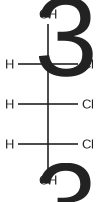
- A2
- B3
- C4
- D6
Show answer and solution
(B) 3 distinct configurations as drawn: two meso forms (with C3 pseudo-asymmetric) and one chiral pair. Total stereoisomers 4 (2 meso + 2 enantiomers), which form 3 diastereomeric sets.
Which can exist as diastereomers?
- A1,3-dichloropropadiene
- B1,2-dichloroethene
- CCFClBrI
- Dtartaric acid
Show answer and solution
(B) and (D). (B): cis and trans. (D): meso and the (R,R)/(S,S) pair. (A) is an allene: its two forms are enantiomers. (C) has one stereocentre: only enantiomers.