Optical Isomerism (Stereochemistry) questions: Enantiomers
5 questions, each with the answer and a worked solution under it. Try each one before you open the answer.
Draw the enantiomer of the following compound.
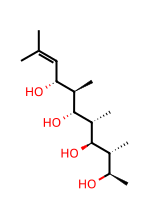
Show answer and solution
Redraw the molecule but invert every stereocentre: every wedge becomes a dash and every dash a wedge.
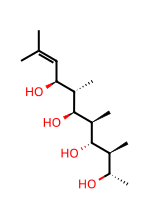
Draw the enantiomer of each of the following compounds.


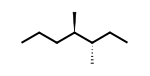
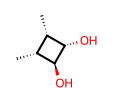
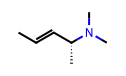

Show answer and solution
Invert every wedge and dash.


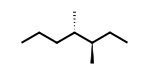
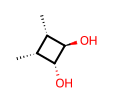
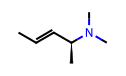

If the inverted drawing can be turned to match the original, the compound is meso (achiral). None of (a) to (f) is: each has a real enantiomer.
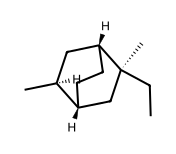
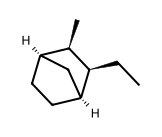
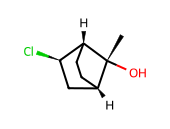
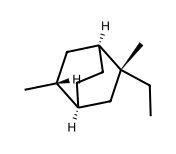
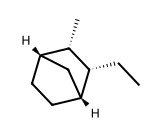
Draw the enantiomer of the following compound (a rigid bicyclic system drawn in perspective, without wedges).
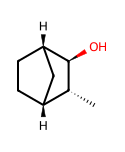
Show answer and solution
For rigid cages and chairs, place a mirror beside the molecule and draw the reflection: left and right swap, up and down stay.
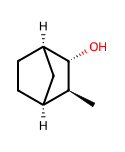
Draw the enantiomer of each of the following compounds.
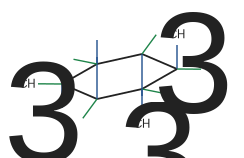
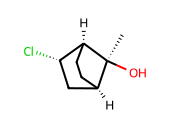
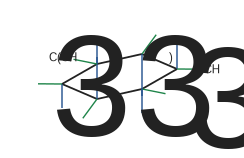
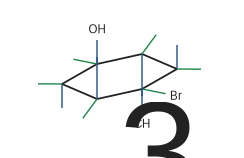
Show answer and solution
Reflect each molecule in a mirror placed beside it. For a chair, the mirror image in the same chair outline swaps the positions on the two sides (here 2 with 6 and 3 with 5); axial stays axial and equatorial stays equatorial.
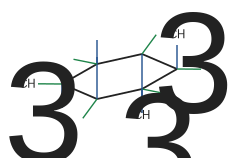
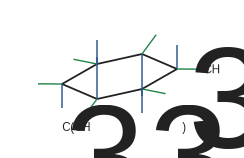
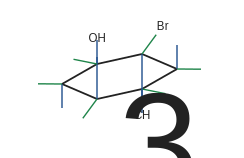
Note on (f): OH and the C(Br)() carbon are 1,4 to each other (4-bromo-4-methylcyclohexan-1-ol). This compound has a plane of symmetry through C1 and C4, so it is achiral; its mirror image is the same compound (the original question still draws a "mirror image").
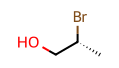
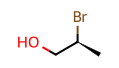
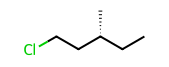
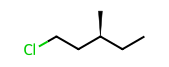
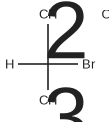
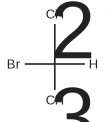
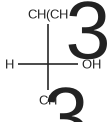
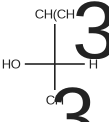
Draw both enantiomers of (1) 2-bromopropan-1-ol (2) 1-chloro-3-methylpentane, (3) 3-methylbutan-2-ol, as perspective drawings and as Fischer projections.
Show answer and solution