Geometrical (cis-trans, E/Z) Isomerism questions: Exercise: single choice
23 questions, each with the answer and a worked solution under it. Try each one before you open the answer.
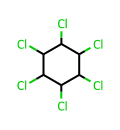
Number of geometrical isomers of the given compound are:
- A6
- B7
- C8
- D9
Show answer and solution
(C) 8. There are 8 cis/trans arrangements of the six Cl (8 diastereomers). One of them is chiral, so the total number of stereoisomers is 9.
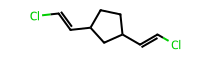
Number of geometrical isomers of the given compound are:
- A2
- B4
- C6
- D8
Show answer and solution
(C) 6. The two side-chain C=C can be EE, ZZ or EZ (EZ = ZE, since the two ends are the same). Each combination can have the ring substituents cis or trans: 3 x 2 = 6.
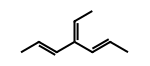
Number of geometrical isomers of the given compound are:
- A1
- B2
- C3
- D4
Show answer and solution
(D) 4. The two outer prop-1-enyl double bonds can each be E or Z. If both are the same (EE or ZZ), the central carbon carries two identical groups and the central C=C is not stereogenic: 1 + 1. If they differ (EZ), the central C=C has two forms: 2. Total 4.
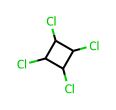
Number of geometrical isomers of the given compound are:
- A1
- B2
- C3
- D4
Show answer and solution
(D) 4. All-cis; three up and one down; 1,2 up and 3,4 down; 1,3 up and 2,4 down.
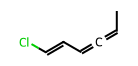
Number of geometrical isomers of the given compound are:
- A1
- B2
- C3
- D4
Show answer and solution
(B) 2. The allene unit (two cumulated C=C) gives optical isomers (axial chirality), not geometrical isomers. Only the CH=CHCl double bond gives E and Z.
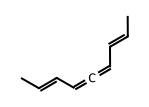
Total number of geometrical isomers possible for the given compound are:
- A16
- B8
- C4
- D2
Show answer and solution
Answer key (C) 4. Note: the two outer C=C are E/Z units and the molecule is symmetrical, so there are 3 geometrical combinations (EE, EZ, ZZ). The central allene (two cumulated C=C) adds axial chirality, not E/Z. Each combination is chiral, so there are 6 stereoisomers in all. The original question's 4 counts EZ and ZE as two.
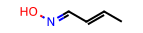
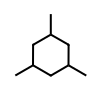
Find the total number of geometrical isomers of the following compounds. has x geometrical isomers; the second compound has y; the third has z. What is the value of x + y + z?

- A16
- B8
- C4
- D10
Show answer and solution
(B) 8. x = 4 (the C=C and the C=N are both stereogenic, ends different: ). y = 2 (all-cis, and two cis with one trans). z = 2 (cis, trans). 4 + 2 + 2 = 8.
Find the total number of geometrical isomers of the following compounds.
- A0
- B8
- C4
- D2
Show answer and solution
Answer key (D) 2. The original question prints no structure for this question, so it cannot be checked.
Which of the following compounds will exhibit geometrical isomerism?
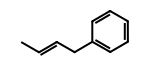
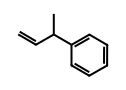
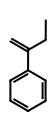
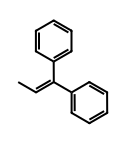
Show answer and solution
(A). : each alkene carbon has two different groups. (B) and (C) have a end; (D) has two phenyls on one carbon.
The number of isomers for the compound with molecular formula is:
- A2
- B3
- C5
- D6
Show answer and solution
(D) 6. The four halogens can be split over the two carbons in 3 ways: (Br,Cl)(F,I), (Br,F)(Cl,I), (Br,I)(Cl,F). Each gives E and Z: 3 x 2 = 6.

Maleic acid and fumaric acid are:
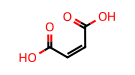
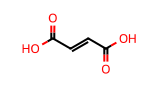
- Aposition isomers
- Bgeometric isomers
- Cenantiomers
- Dfunctional isomers
Show answer and solution
(B).
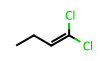
Which of the following compounds does not exhibit geometrical isomerism?



Show answer and solution
(C). One alkene carbon carries two Cl.
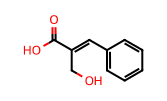
The Z-isomer among the following is:


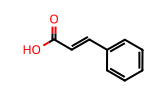
Show answer and solution
(A). In (A) the two higher groups, (vs H) and ethyl (vs ), are on the same side. (B) E. (C) E: phenyl and are opposite. (D) E (trans-cinnamic acid).
Which of the following is an E isomer?

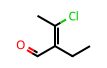
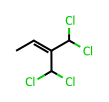

Show answer and solution
(B). Cl > ; CHO > ethyl; Cl and CHO are on opposite sides. (A) is Z (Cl and Br same side). (C) has two identical groups on one carbon and (D) has two H on one carbon: no E/Z.
Which of the following statements about cis-trans isomerism is/are correct? (1) All alkenes exhibit cis-trans isomerism. (2) But-2-ene exhibits cis-trans isomerism. (3) A pair of cis-trans isomers may be optically active.
- A(1) only
- B(2) only
- C(1) and (3) only
- D(2) and (3) only
Show answer and solution
(D). (1) is false (propene, isobutene). (3) is true: for example trans-1,2-dimethylcyclopropane is chiral.
Relationship between (A) and (B) is:


(A) diastereomers (B) enantiomers (C) identical (D) structural isomers
Show answer and solution
(A). (A) is cis-cyclooctene and (B) is trans-cyclooctene. Geometrical isomers are diastereomers.
Geometrical isomerism is possible in:


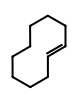
Show answer and solution
(D). A trans C=C fits only in a ring of 8 or more atoms. Cyclodecene exists as cis and trans; the smaller rings are cis only.
Which of the following compounds could exhibit geometrical isomerism? (1) 3,4-dimethylhex-3-ene (2) 2-methylpent-2-ene (3) 1,6-dichlorohex-3-ene
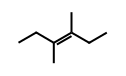
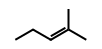

- A(1) and (2) only
- B(1) and (3) only
- C(2) and (3) only
- D(1), (2) and (3)
Show answer and solution
(B). (2) has two on C2.
Which of the following compounds has/have a pair of geometrical isomers? (1) (2) (3)

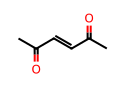
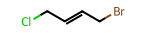
- A(1) only
- B(2) only
- C(1) and (3) only
- D(2) and (3) only
Show answer and solution
(D).
Which of the following statements concerning geometrical isomers is/are correct? (1) The cis isomer has a higher melting point than the trans isomer. (2) A pair of geometrical isomers has the same functional group. (3) Any organic compound with a carbon-carbon double bond has geometrical isomers.
- A(1) only
- B(2) only
- C(1) and (3) only
- D(2) and (3) only
Show answer and solution
(B). The trans isomer usually packs better and melts higher, so (1) is false. (3) is false (ethene, propene).
Which of the following are the types of structural isomerism? (1) Geometrical isomerism (2) Functional group isomerism (3) Chain isomerism
- A(1) and (2) only
- B(1) and (3) only
- C(2) and (3) only
- D(1), (2) and (3)
Show answer and solution
(C). Geometrical isomerism is stereoisomerism.
Which of the following statements concerning a pair of geometrical isomers are correct? (1) They have different boiling points and melting points. (2) They have the same relative molecular mass. (3) Their atoms are joined in the same order.
- A(1) and (2) only
- B(1) and (3) only
- C(2) and (3) only
- D(1), (2) and (3)
Show answer and solution
(D).
Which of the cycloalkanes is not capable of showing cis-trans isomerism?
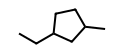


Show answer and solution
(D). Both methyls are on the same carbon.