Geometrical (cis-trans, E/Z) Isomerism questions: Solved examples
9 questions, each with the answer and a worked solution under it. Try each one before you open the answer.
Name the following substances, including the cis- or trans- prefix.


Show answer and solution
(a) trans-1,3-dimethylcyclopentane (b) cis-1,2-dichlorocyclohexane. The ring is taken as lying in the plane of the page. A wedge comes out of the page, a dash goes behind it. Both wedged or both dashed = cis; one of each = trans.
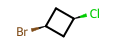
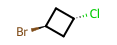
Name the following, including the cis- or trans- prefix.
Show answer and solution
(a) cis-1-bromo-3-chlorocyclobutane (H atoms on the same face) (b) trans-1-bromo-3-chlorocyclobutane.
Draw the cis and trans isomers of:
- A1-ethyl-3-methylcyclobutane
- B3,4-dimethylhept-3-ene
- C1-bromo-4-chlorocyclohexane
- D1,3-dibromocyclobutane.
Show answer and solution
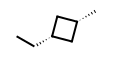
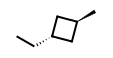
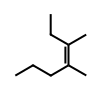
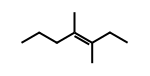
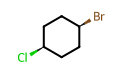
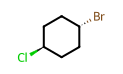
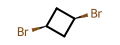
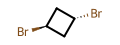
For (B) the original question uses cis/trans for the two methyl groups. E/Z is clearer here, since each alkene carbon carries two alkyl groups: the cis-dimethyl form is (E), because ethyl and propyl (the higher groups) are then on opposite sides.
Draw and label the E and Z isomers of each of the following compounds.
Show answer and solution

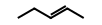
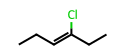

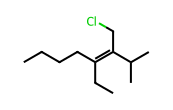
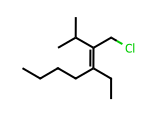
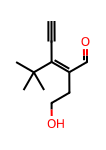
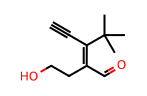
Priorities used:
- Ethyl > H on one carbon; methyl > H on the other.
- Cl > ethyl on C3; ethyl > H on C4.
- Butyl > ethyl on one carbon (they tie at C, then (C,H,H) vs (C,H,H), and butyl wins further out). On the other carbon, (Cl,H,H) > isopropyl (C,C,H): the single highest atom (Cl) decides.
- CHO (O,O,H) > (C,H,H). On the other carbon both groups are (C,C,C) at the first atom. Go one step out: tert-butyl branches are three (H,H,H); the alkyne branches are the real terminal C (C,C,H) plus duplicate atoms. (C,C,H) beats (H,H,H), so CCH > .
Draw the structure of (Z)-3-isopropylhept-2-ene.
Show answer and solution
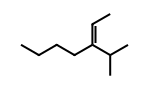
On C2: > H. On C3: isopropyl (C,C,H) > butyl (C,H,H). Z: and isopropyl on the same side.
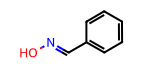
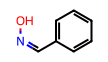
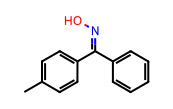
Name the following oximes using syn/anti and E/Z.
Show answer and solution
(I) syn-benzaldoxime = (E)-benzaldoxime: H and OH on the same side, so phenyl (higher) and OH are opposite. (II) anti-benzaldoxime = (Z)-benzaldoxime. (III) p-tolyl outranks phenyl, and OH is on the p-tolyl side, so it is (Z). In syn/anti terms it is syn-p-tolyl phenyl ketoxime (or anti-phenyl p-tolyl ketoxime).
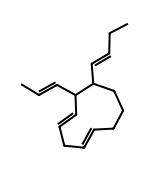
X = total number of possible geometrical isomers of the compound below. Find X/4.
Show answer and solution
8. Units that can be cis/trans or E/Z: the two ring C=C (a 10-membered ring can hold both geometries), the two side-chain C=C, and the ring C-C bond carrying the two side chains (cis or trans substituents). n = 5, the molecule is unsymmetrical, so X = = 32 and X/4 = 8.
Draw the four isomers of hepta-2,4-diene and the three of hexa-2,4-diene, with cis/trans and E/Z labels.
Show answer and solution
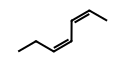
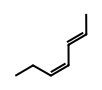
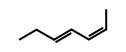

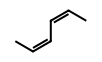
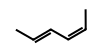

Hepta-2,4-diene has different ends: = 4 isomers. Hexa-2,4-diene has identical ends: (Z,E) and (E,Z) are the same compound, so 3 isomers. The labels are listed in the order the double bonds are numbered.
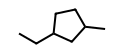
Which of the following compounds will show geometrical isomerism?


Show answer and solution
All four. Each has two substituents on two different ring carbons, so cis and trans forms exist.