Acidic and Basic Strength questions: Steric inhibition, ortho effect, H-bonding
19 questions, each with the answer and a worked solution under it. Try each one before you open the answer.
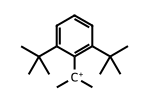
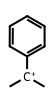
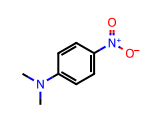
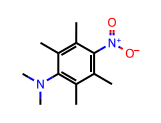
Compare the stability of the cations (A) 2,6-di-tert-butylphenyl-substituted 2-propyl cation and (B) cumyl cation; and explain the dipole moments: 4-nitro-N,N-dimethylaniline 6.87 D vs its 2,3,5,6-tetramethyl derivative 4.11 D; nitrobenzene 3.95 D vs 2,3,5,6-tetramethylnitrobenzene 3.39 D.
Show answer and solution
B > A. In A the bulky ortho groups twist the cationic centre out of the ring plane (SIR), so the ring cannot delocalise the charge. In the tetramethyl compounds the and groups are twisted out of the ring plane, so the push-pull resonance (which makes the large dipole) is lost and the dipole falls.
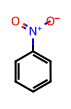
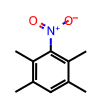
Explain the dipole moments: nitrobenzene 3.95 D, 2,3,5,6-tetramethylnitrobenzene 3.39 D.
Show answer and solution
Steric inhibition of resonance (S.I.R.). The two ortho methyls push the group out of the ring plane. Its p orbitals no longer overlap with the ring, so the resonance that moves electron density from the ring onto is lost. Less charge separation gives the smaller dipole moment. (The two meta methyls only buttress the ortho ones.)
Compare the C-N bond lengths in nitrobenzene (X, bond a) and 2,6-dimethoxynitrobenzene (Y, bond b).
Show answer and solution
b > a. In Y the ortho OMe groups twist the out of plane, so the C-N bond loses its partial double-bond character.
Compare the acid strength of the o-, m- and p- isomers of (1) toluic acid (2) methoxybenzoic acid (3) nitrobenzoic acid.
Show answer and solution
(1) o > m > p: ortho effect; m feels only +I; p feels +I and +H. (2) o > m > p: ortho effect; at m OMe is only -I; at p its +M weakens the acid. (3) o > p > m: ortho effect; at p withdraws by -M and -I; at m only -I. (Measured of m- and p-nitrobenzoic acid are nearly equal, 3.45 and 3.44.)
Explain: 2,6-dihydroxybenzoic acid ( 2.30) > 2-hydroxybenzoic acid (2.98) > benzoic acid (4.17). Rank the nitrophenols.
Show answer and solution
Each ortho OH donates an H-bond to the carboxylate oxygen and stabilises the anion; two H-bonds help more than one. Nitrophenols: p > o > m (o is held back by its internal H-bond between OH and ).
Explain: (1) is more acidic than (2) 1,3-dithiolane is more acidic than 1,3-dioxolane at C2 (3) cyclopentadiene is far more acidic than cyclopropene.


Show answer and solution
(1), (2): the original question uses "d-orbital resonance". The modern explanation is that the larger, more polarisable Cl and S atoms stabilise an adjacent carbanion better (partly through overlap with low-lying C-Cl or C-S orbitals); real d-orbital participation is negligible. The observed orders are correct. (3) cyclopentadienide is aromatic (6 e); the cyclopropenyl anion is antiaromatic (4 e).
Predict the direction of each equilibrium (original in brackets). (a) (b) (c) (d) + a ketone enolate (e) NaF + HCl (f) ArOH + (g) an ester + (h) a -diketone + (i) an acetylide + (j) +
Show answer and solution
The side with the weaker acid is favoured. (a) left (: , 33-36, is far weaker than water) (b) right () (c) right () (d) right (about 10: alcohol 18 vs ketone 19) (e) right (HF, 3.2, is the weaker acid) (f) neither side (both about 10) (g) right (about ) (h) right (about : diketone 9, about 10-12) (i) right (: alcohol 16 vs alkyne 25) (j) right (: alkene 44 vs methane 50).
Rank from least (1) to most acidic (4): (a) , , H-F, (b) HCl, HF, HBr, HI (c) propan-2-ol, HOCl, acetic acid, the aldehyde C-H of acetaldehyde (d) propanoic acid O-H, butan-2-one C-H, propanamide N-H, ethanol O-H
Show answer and solution
(a) C-H 1 < N-H 2 < O-H 3 < F-H 4. (b) HF 1 < HCl 2 < HBr 3 < HI 4. (c) original: aldehyde C-H 1 < HOCl 2 < propan-2-ol 3 < acetic acid 4. Note: HOCl ( 7.5) is in fact much more acidic than propan-2-ol (about 17), so the correct order is 1 aldehyde C-H, 2 propan-2-ol, 3 HOCl, 4 acetic acid. (d) original: ethanol 1 < ketone C-H 2 < amide N-H 3 < acid 4. Note: on the usual scale ethanol (about 16) is more acidic than a ketone C-H (about 19-20); the amide N-H is about 17 in water... these three are close, so only "acid is most acidic" is certain.
Rank from least (1) to most (4) acidic: (e) propanoic, 2-fluoropropanoic, 2-chloropropanoic, 3-chloropropanoic acids (f) ethanol, propan-2-ol, methanol, tert-butanol (g) butan-1-ol and its 1-, 2- and 3-fluoro derivatives (h) acetoacetic acid O-H, hydroxyacetone O-H, butanone C-H, trichloroacetic acid
Show answer and solution
(e) propanoic 1 < 3-chloro 2 < 2-chloro 3 < 2-fluoro 4. (f) tert-butanol 1 < propan-2-ol 2 < ethanol 3 < methanol 4 (in solution). (g) butan-1-ol 1 < 3-fluoro 2 < 2-fluoro 3 < 1-fluoro 4 (F closest to O-H helps most). (h) ketone C-H 1 < hydroxyacetone O-H 2 < acetoacetic acid 3 < trichloroacetic acid 4.
Order of acidity: (a) phenol (b) o-cresol (c) m-cresol (d) p-cresol.
Show answer and solution
a > c > d > b. Methyl destabilises the phenoxide: by +I only at meta; by +I and +H at ortho and para; +I is largest at ortho.
Order of acidity: (a) phenol (b) o-nitrophenol (c) m-nitrophenol (d) p-nitrophenol (e) 2,4-dinitrophenol (f) 2,4,6-trinitrophenol.
Show answer and solution
f > e > d > b > c > a. More nitro groups at o/p, more -M stabilisation. o-Nitrophenol is a little weaker than p because of its intramolecular H-bond.
Order of acidity: (I) p-toluic acid (II) cyclohexanol (III) phenol (IV) p-nitrobenzoic acid.
- AIV > II > I > III
- BIV > III > I > II
- CIV > I > II > III
- DIV > I > III > II
Show answer and solution
(D). Carboxylic acids beat phenol, which beats an alcohol. Among the acids, p- (-M, -I) strengthens and p- (+I, +H) weakens.
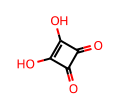
Squaric acid is a diprotic acid, both protons more acidic than acetic acid. In the dianion all C-C bonds are equal and all C-O bonds are equal. Explain.
Show answer and solution
The monoanion is resonance stabilised and held by an intramolecular H-bond. In the dianion the two charges and two C=O bonds are spread over four equivalent resonance structures, so all four C-O bonds and all four C-C bonds become identical.
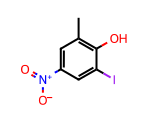
Which is more acidic: 2-iodo-6-methyl-4-nitrophenol or 3-iodo-5-methyl-4-nitrophenol? Explain with canonical forms.
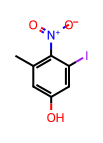
Show answer and solution
(A). In A the nitro group is free to lie in the ring plane, so the phenoxide charge reaches the nitro oxygens (-M). In B the nitro group is flanked by I and , so it is twisted out of plane (SIR) and only its -I effect remains.
Decreasing acidity: (I) benzoic acid (II) p-nitrophenol (III) m-nitrophenol (IV) benzenesulfonic acid.
- AI > II > IV > III
- BII > I > IV > III
- CII > IV > I > III
- DIV > I > II > III
Show answer and solution
(D). Sulfonate has three equivalent resonance forms; carboxylate two; then the nitrophenols (p with -M, m with -I only).
Benzoic acid with gives gas A; with NaH gives gas B. Find (molar mass of A + B) - 10. Similarly, for acetic acid with NaH (gas A) and (gas B), find (M(A) + M(B)) - 15.
Show answer and solution
A = (17), B = (2). First: 17 + 2 - 10 = 9. Second: A = , B = : 2 + 17 - 15 = 4.
Acetic acid with NaH gives gas (A); with it gives gas (B). If X is the sum of the molar masses of A and B, find X - 15.
Show answer and solution
4. : A = (M = 2). : B = (M = 17). X = 19, so X - 15 = 4.
Which gas is evolved? (1) (2) p-nitrophenol + (3) picric acid + (4) phenol + NaH. Also: does 2,4-dinitrophenol react with ? Does squaric acid?
Show answer and solution
(1) (3) (4) . 2,4-Dinitrophenol ( 4.1) and squaric acid both give . (2) The original question says . Note: p-nitrophenol ( 7.2) is weaker than carbonic acid ( 6.4), so with it gives little or no visible effervescence; the clear-cut cases are well below 6.4.
A mixture of p-toluic acid, 4-methylcyclohexanol and p-xylene is dissolved in ether and shaken with aqueous . The ether layer is then shaken with NaOH (giving flask 1, aqueous, and flask 2, ether). The first aqueous layer is acidified with HCl and extracted (flask 3, ether, and flask 4, aqueous). Which flask holds 4-methylbenzoic acid?
Show answer and solution
Flask 3. takes the acid into water as its sodium salt; HCl gives back the free acid, which goes into ether. Flask 4 holds NaCl. Flask 2 holds p-xylene. The original question puts 4-methylcyclohexanol (as its alkoxide) in flask 1. Note: an alcohol ( about 16-18) is not extracted by aqueous NaOH to a useful extent, so in practice it stays in flask 2 with the xylene.