Acidic and Basic Strength questions: Exercise: single choice
21 questions, each with the answer and a worked solution under it. Try each one before you open the answer.
most acidic: (I) benzoic (II) o-toluic (III) m-toluic (IV) p-toluic acid.
Show answer and solution
(B) (ortho effect).
most acidic phenol: (I) p-nitrophenol (II) 2,4-dinitrophenol (III) picric acid (IV) o-nitrophenol.
Show answer and solution
(C).
highest :
- A-chlorobutyric
- B-chlorobutyric
- C-fluorobutyric
- D-fluorobutyric acid
Show answer and solution
(C).
Which marked H is most acidic?
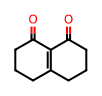
- AHa
- BHb
- CHc
- DHd
Show answer and solution
Answer key (A) Ha. Removing Ha gives an anion conjugated through the ring C=C to both carbonyl groups (a vinylogous, doubly stabilised enolate), while Hb or Hc gives an ordinary enolate of one C=O.
order of acidity: (a) benzoic (b) salicylic (c) 2,6-dihydroxybenzoic acid:
- Aa > b > c
- Bb > c > a
- Cc > b > a
- Dnone.
Show answer and solution
(C).
which bases can deprotonate water? (a) (b) (c) (d) (e) the acetone enolate (f) .
- Aa,b,c,d,e
- Bb,c,d,e,f
- Ca,b,d,e
- Db,c,d,e
Show answer and solution
(C): a base deprotonates water if its conjugate acid has above 15.7 (ethanol about 16, propyne 25, ammonia 36, acetone 19). HCl and acetic acid are far stronger acids than water.
Which carbon is deprotonated first by base?
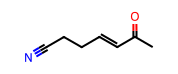
- A4
- B5
- C2
- D3
Show answer and solution
Answer key (A) C4: its anion is an extended (dienolate) system, delocalised through C3=C2 onto the carbonyl O. Note: the C1 methyl (an ordinary ketone position) is also acidic and is the site a hindered strong base such as LDA removes fastest (kinetic control). The C4 anion is the more stable (thermodynamic) one.
which does NOT give with ?
- Abenzoic acid
- Bphenol
- Cbenzenesulfonic acid
- Dpicric acid.
Show answer and solution
(B).
order of acidity: (I) phenol (II) 4'-nitrobiphenyl-4-ol (III) 3'-nitrobiphenyl-4-ol (IV) biphenyl-4-ol.
- AI > II > III > IV
- BII > III > IV > I
- CII > III > I > IV
- DIII > II > IV > I.
Show answer and solution
(B): the second ring withdraws a little (-I of C, and resonance), and a 4'- can pull charge through both rings.
most acidic species:
- Apyrrolidinium
- Bpyrrolium (N-protonated pyrrole)
- Cpyridinium
- D4-dimethylaminopyridinium
Show answer and solution
(B): protonating pyrrole destroys its aromaticity, so its conjugate acid is very strong ( about -3.8).
decreasing acidity: (I) benzoic (II) salicylic (III) p-hydroxybenzoic (IV) 2,6-dihydroxy-4-methylbenzoic acid.
- AI > II > III > IV
- BI > III > II > IV
- CIV > II > III > I
- DIV > II > I > III.
Show answer and solution
(D).
order: (I) HCOOH (II) (III) PhCOOH (IV) .
- AI > II > III > IV
- BIV > I > II > III
- CIII > IV > I > II
- DI > III > II > IV
Show answer and solution
(D): 3.75, 4.2, 4.76, 6.4.
which releases with aqueous ?
- Aphenol
- Bcyclohexanol
- Cbenzoic acid
- Dbenzamide.
Show answer and solution
(C).
the compound below reacts with 2 mol . The product is:
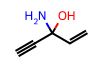
- AN and alkyne deprotonated
- BN and O deprotonated
- CO and alkyne deprotonated
- DO and the vinyl C-H deprotonated
Show answer and solution
(C): the two most acidic H are the O-H ( about 13-16) and the alkyne C-H (25); the (about 35) stays.
Which of the given compounds is the strongest acid?
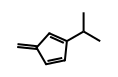
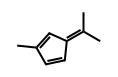
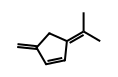
- A1
- B2
- C3
- Dboth 1 and 2
Show answer and solution
Answer key (B). Checked: (C) 3. Only 3 has an ring . Removing a proton there gives a fully conjugated anion whose charge can sit on the ring carbons (cyclopentadienide, aromatic) and on the exocyclic carbons. 1 and 2 are fulvenes with no ring C-H; their only C-H are on methyl or isopropyl groups, whose anions are far less stabilised.6).
order of basicity of the three N atoms in 3-amino-4-(aminomethyl)pyridine: (1) the ring (2) the (3) the ring N.
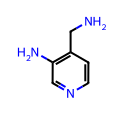
- A2 > 1 > 3
- B2 > 3 > 1
- C3 > 2 > 1
- D3 > 1 > 2.
Show answer and solution
(B): alkyl amine (about 9-10) > pyridine N (about 5-6) > aryl amine (lone pair delocalised).
order of basicity (): (1) ethylamine (2) the imine (3) acetamidine (4) guanidine.
- A4 > 3 > 2 > 1
- B1 > 2 > 3 > 4
- C4 > 3 > 1 > 2
- D1 > 4 > 3 > 2
Show answer and solution
(C): guanidinium and amidinium cations are resonance stabilised; an imine N is less basic than an amine.
which is a weaker base than ethylamine?
- Aaniline
- Bacetamidine
- Cguanidine
- Da cyclic amidine.
Show answer and solution
(A).
compare the basicity of four bicyclic compounds: (1) a bicyclic guanidine (2) a bicyclic aminal with two NH (3) a bicyclic bis-lactam (4) a bicyclic amidine.
- A1 > 4 > 2 > 3
- B2 > 1 > 4 > 3
- C2 > 4 > 1 > 3
- D1 > 2 > 4 > 3.
Show answer and solution
(A): guanidine > amidine > ordinary amine > amide.
most basic:
- Abenzylamine
- Baniline
- Cacetanilide
- Dp-nitroaniline.
Show answer and solution
(A).
decreasing basicity of , , , :
- A
- B
- C
- D
Show answer and solution
(A).