Topic 7 of 10
-Dicarbonyl compounds
Tautomerism notes: -Dicarbonyl compounds, explained step by step.
When two C=O groups flank one , the enol is greatly stabilised:
- Conjugation: the enol C=C is conjugated with the remaining C=O (the keto form has no conjugation).
- Intramolecular H-bond: a six-membered chelate ring (worth about 29 kJ/mol).
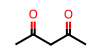
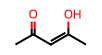
| Compound | % enol (neat or hexane) |
|---|---|
| pentane-2,4-dione (acac) | 76-92 |
| benzoylacetone | about 90 or more |
| ethyl acetoacetate | 8 (liquid); 46 in hexane, 10 in ethanol |
| diethyl malonate | about 0.008 |
| ethyl cyanoacetate | 0.25 |
| cyclohexane-1,3-dione | high (mostly enol) |
| cyclopentane-1,3-dione | essentially all enol |
Trends in enol content
- Ketone > ester: replacing an alkyl by OR (acac to ethyl acetoacetate to diethyl malonate) lowers the enol content. The OR group's own resonance with C=O competes with (cross-conjugates) the enol.
- Solvent: non-polar solvents favour the internally H-bonded enol; polar, H-bonding solvents (water, ethanol) favour the keto form. acac: 92 % enol in hexane, 15 % in water.
- Extra conjugation (aryl groups) raises the enol content.
- Electronegative groups on the central carbon help slightly; a bulky group there twists the system and can lower the enol content (3-methyl-acac 44 %, 3-tert-butyl derivative almost 0 %).
- C=S vs C=O: the C=S bond is weak, so thio-ketones enolise more (thioenols).
- Ring size: cyclohexanone and the medium rings (8-10) enolise more than cyclopentanone.
Sulfones do not chelate
-Keto sulfones and -disulfones hardly enolise and show no O-H...O band; sulfonyl groups do not form the stabilising chelate.