Tautomerism questions: Subjective
4 questions, each with the answer and a worked solution under it. Try each one before you open the answer.
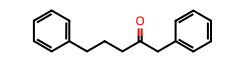
Treating 1,5-diphenylpentan-2-one with basic quickly replaces two H atoms by D. Then, more slowly, all other non-aromatic H atoms except one (marked H, on C4) are replaced. How?
Show answer and solution
The benzylic next to C=O (C1) is the most acidic (enolate conjugated with the ring), so its two H exchange first. Enolisation toward C3 is slower and exchanges the C3 H atoms. Enolisation toward the C3 side, followed by deuteration at the carbon next to the ketone and loss of the remaining proton back to the dienol, exchanges the rest. The marked C4-H is never directly to the C=O and is the one left.
which shows easy keto-enol tautomerism: (a) phloroglucinol or (b) 1,2,4-trihydroxybenzene?
Show answer and solution
(a) phloroglucinol. Its triketo form, cyclohexane-1,3,5-trione, is easily reached (three strong C=O bonds offset the lost aromaticity) and it reacts with hydroxylamine to give a trioxime. In (b) the keto form would put two C=O on adjacent carbons and is less favourable.
which has the higher enol content: (a) cyclohexane-1,3,5-trione or (b) cyclohex-5-ene-1,3-dione (below)?


Show answer and solution
both can tautomerise all the way to aromatic phenols: (a) to phloroglucinol, (b) to resorcinol. The original question picks (a): its enol form (phloroglucinol) is reached by three enolisations, each one making the ring more aromatic, and the trione itself is not isolable.).
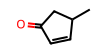
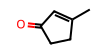
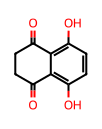
Draw mechanisms for these reactions using only enolisation and its reverse (trace of acid or base). In (b) the black dots mark C atoms.
Show answer and solution
(a) The ketone forms two possible enols. One leads back to the start; the other, after protonation at a different carbon, gives the conjugated enone with the more substituted C=C. All steps are reversible, so the mixture ends at the most stable isomer. (b) The label does not move. Repeated enolisation and ketonisation simply move the C=O and OH functions around the rings until the carbonyl sits on the other ring.