Tautomerism questions: Solved examples
3 questions, each with the answer and a worked solution under it. Try each one before you open the answer.
Which of the following compounds can undergo tautomerism in a base-catalysed medium?

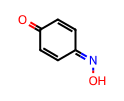
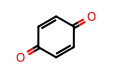

Show answer and solution
(1), (2) and (4). (1) Base removes an H from the (C4); the enolate gives phenol, which is aromatic. (2) Base removes the oxime O-H; the anion re-protonates on oxygen of the C=O side and gives p-nitrosophenol (oxime-nitroso tautomerism, with an aromatic ring). (3) p-Benzoquinone has no H on an carbon and no O-H or N-H: no tautomerism. (4) Norbornan-2-one enolises through its carbon (C3). It cannot enolise toward the bridgehead C1 (Bredt's rule).
Which H atoms are exchanged for D when this hydroxy diketone is treated with base in ?
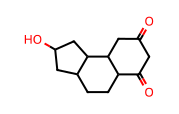
Show answer and solution
The O-H (fast, it becomes O-D) and every -H of the two ketones: the between the two C=O (2), the other next to C=O (2) and the ring-fusion CH next to a C=O (1). C-H atoms not to a C=O do not exchange.
An optically active ketone whose only stereocentre is the carbon (bearing H and Ph) racemises with in BuOH. Why?
Show answer and solution
Base removes the -H at the stereocentre and forms a planar, achiral enolate. Protonation occurs equally from both faces, giving a racemic mixture.