Resonance questions: Patterns
5 questions, each with the answer and a worked solution under it. Try each one before you open the answer.
Draw the resonance contributors of (a) pyrrole (b) the cyclopentadienyl anion (c) the acetylacetone anion (d) the nitroacetone anion.
Show answer and solution
(a) The N lone pair moves into the ring; N becomes + and the negative charge visits the ring carbons (two more contributors are mirror images of these):


(b) The lone pair moves round the ring: five equivalent contributors, each carbon carries .


(c) Charge on the central C and on either O:
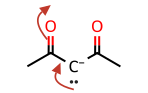
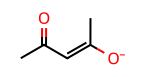
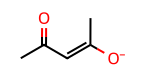
(d) Charge on C, on the ketone O, and on the nitro O atoms:
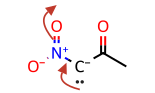
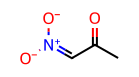
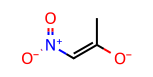
Delocalising the positive charge of the nitro N is possible on paper, but those structures contribute very little.
Use orbital pictures to show where the electrons are in each resonance form of formamide, .
Show answer and solution
Major form: C=O bond, N lone pair in a p orbital parallel to the C=O p orbitals. Minor form: the N lone pair has become an N=C bond and the C=O pair is now a lone pair on O (, ). For this overlap N must be and the amide planar.
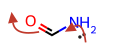

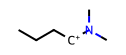
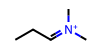
Locate the pattern (lone pair next to a positive charge) and draw the resonance structure.

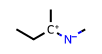

Show answer and solution


Draw the resonance contributors of the cyclopropenyl cation and the tropylium (cycloheptatrienyl) cation.
Show answer and solution
Push the bond toward the cationic carbon each time; the charge moves round the ring. Cyclopropenyl: 3 equivalent contributors, each C carries . Tropylium: 7 equivalent contributors, each C carries .


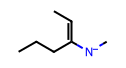
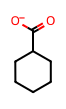
Locate the pattern and draw the resonance structure of each.



Show answer and solution


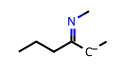
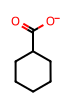


1 lone pair of ring O into C=O (minor, charge separated). 2 enol-ether type: O lone pair pushes the C=C. 3 enamine: N lone pair, carbanion on C. 4 enol: carbanion on C. 5 allylic anion: the charge moves to the other end of the allyl unit. 6 the N lone pair (negative) makes C=N; the C=C becomes a carbanion. 7 carboxylate: the two O atoms swap. 8 nitroalkene: the C=C bond moves toward N while an N=O pair moves onto O, giving a cation on the far carbon.