Topic 2 of 10
Reading bond-line drawings
Representation of Organic Compounds notes: Reading bond-line drawings, explained step by step, with 1 worked example.
How to read bond-line drawings
- Every corner (vertex) and every line end is a carbon. The most common mistake is forgetting the end carbons.
- One line = single bond, two lines = double bond, three lines = triple bond.
- H atoms on carbon are not drawn. A neutral carbon has 4 bonds in total, so: line end = , two-way corner = , three-way junction = CH, four-way junction = C (no H).
- All atoms other than C and H are written, together with any H on them (OH, SH, ).
- Lone pairs are usually not shown; they follow from the charge (see below).
Triple bonds are straight
A CC unit is linear. The two triple-bonded carbons and the two carbons attached to them lie in one straight line. So a straight segment with a triple bond in the middle hides four carbons, not two.

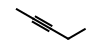
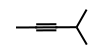

Worked example: Count the carbons
How many carbons are in hept-3-yne, and how many atoms lie on one straight line?
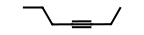
Show answer and solution
7 carbons. C2, C3, C4 and C5 (the triple-bond carbons and their two neighbours) are collinear: 4 atoms on one line.