Topic 2 of 11
Curly arrows: the bookkeeping of electrons
Basic Organic Chemistry: Reagents and Curly Arrows notes: Curly arrows: the bookkeeping of electrons, explained step by step.
A mechanism shows how electrons move when bonds break and form. A curly arrow shows the movement of one electron pair (double barb). A fish-hook (single barb) moves one electron and is used for radicals.
Tail and head
Tail = where the pair comes from: a lone pair or a bond ( or ). Head = where the pair goes: to form a new bond, or to become a lone pair on an atom that can hold it.
This gives only four kinds of arrow.
| Arrow type | Example |
|---|---|
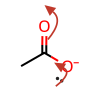
| lone pair bond | attacks C of C=O; attacks of |
| bond lone pair | C-Cl breaks, Cl leaves as |
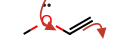
| bond bond | a C=C bond moves along a chain (allylic shift, resonance) |
| lone pair lone pair | rare; only in some resonance drawings |
Rules that catch most mistakes
- An arrow never starts from a proton or from a positive charge with no electrons. To protonate a group, draw the arrow from the lone pair (or bond) to .
- B, C, N and O can hold at most eight electrons. If you push a new bond onto a neutral C, N, O or H that already has a full shell, another bond to it must break in the same step.
- Charge is conserved. The sum of charges on the left equals the sum on the right.
- In one step, arrows flow in one direction (head of one leads to tail of the next). Two arrows pointing at each other mean electrons flowing both ways at once, which is impossible.
Five-bonded carbon
"Adding" to without breaking C-I gives carbon with five bonds. The correct arrows: P lone pair C, and C-I bond I.