Optical Isomerism (Stereochemistry) questions: D/L, sugars and counting
15 questions, each with the answer and a worked solution under it. Try each one before you open the answer.
Which Fischer projection is L-glucose?
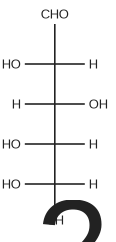
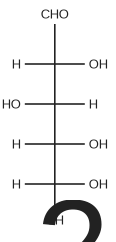
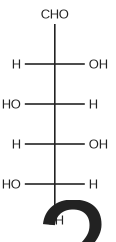
Show answer and solution
(A). L-glucose is the mirror image of D-glucose, so every OH changes side. (B) is D-glucose itself. D-Glucose and D-mannose are C2 epimers; D-glucose and D-galactose are C4 epimers.
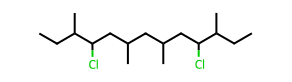
How many stereoisomers (enantiomers and diastereomers) are there of this molecule? Note the possible symmetry of the stereoisomers is a function of the absolute configurations.
Show answer and solution
Stereocentres: C3, C4, C6, C8, C10, C11, so n = 6. The molecule is symmetrical about C7 (C7 itself is ). For even n: optically active = 32, meso = 4, total 36.
Name and give stereochemical labels for all isomers of (a) bromochlorocyclobutane (b) dichlorocyclobutane (c) bromochlorocyclopentane (d) diiodocyclopentane (e) dimethylcyclohexane. Mark chiral carbons.
Show answer and solution
(a) 1-bromo-1-chloro (achiral); 1-bromo-2-chloro: cis (R,S and S,R, a racemic pair) and trans (R,R and S,S); 1-bromo-3-chloro: cis and trans, both achiral (no chiral C). (b) 1,1; cis-1,2 (meso); trans-1,2 (pair); cis- and trans-1,3 (achiral). (c) 1,1; cis-1,2 pair; trans-1,2 pair; cis-1,3 pair; trans-1,3 pair. (d) 1,1; cis-1,2 (meso); trans-1,2 (pair); cis-1,3 (meso); trans-1,3 (pair). (e) nine: 1,1; cis-1,2 (meso); trans-1,2 (pair); cis-1,3 (meso); trans-1,3 (pair); cis-1,4 and trans-1,4 (achiral, no chiral C).
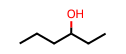
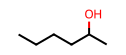
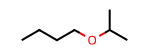
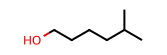
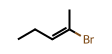
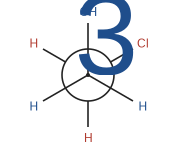
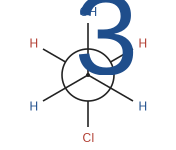
Find the relation between each given pair.



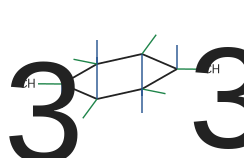
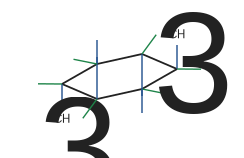
Show answer and solution
(1) constitutional (position) isomers: hexan-3-ol and hexan-2-ol. (2) conformers of 1-chloropropane (gauche and anti). (3) constitutional (functional) isomers: isopropyl butyl ether and 5-methylhexan-1-ol, both . (4) enantiomers. (5) geometrical isomers (diastereomers): (E)- and (Z)-2-bromopent-2-ene. (6) conformers (ring flip of trans-1,4-dimethylcyclohexane, e,e and a,a).
Find the relation between each given pair.


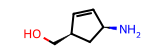
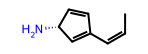
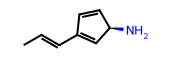
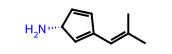
Show answer and solution
(a) enantiomers (b) identical (c) original: positional isomers (d) geometrical isomers (e) identical (f) homologues. Note on (c): as printed, the two drawings in (c) are the same as in (b), so they are identical. The original question's answer "positional isomers" fits only if one drawing had the (or the C=C) at another ring position.
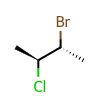
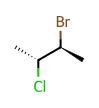
How many stereoisomers does 2-bromo-3-chlorobutane have, and how are they related?
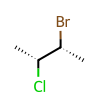
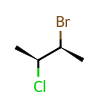
Show answer and solution
4 (2 stereocentres, ends different). A/B and C/D are pairs of enantiomers; every other pair (A/C, A/D, B/C, B/D) are diastereomers.
How many pairs of diastereomers are possible for hexa-2,4-diene?
- A0
- B2
- C3
- D4
Show answer and solution
(C) 3. The three isomers (Z,Z), (Z,E), (E,E) are all diastereomers of one another: three pairs.
(a) How many structural isomers contain a cyclopropane ring? (b) Total cyclic structural plus stereo isomers of ? (c) Of (cyclic alcohols only)? (d) Five-membered-ring isomers of (structural plus stereo)?
Show answer and solution
(a) 6: propyl-, isopropyl-, 1-ethyl-1-methyl-, 1-ethyl-2-methyl-, 1,1,2-trimethyl-, 1,2,3-trimethylcyclopropane. (b) 7: cyclopentane, methylcyclobutane, ethylcyclopropane, 1,1-dimethylcyclopropane, cis-1,2 (meso) and the trans-1,2 pair. (c) 7: cyclobutanol, cyclopropylmethanol, 1-methylcyclopropanol, and 2-methylcyclopropanol (two stereocentres, 4 isomers). (d) 8: 1,1-dimethyl (1), ethyl (1), 1,2-dimethyl (3: cis meso + trans pair), 1,3-dimethyl (3).
Explain why the biphenyl with Br and I at the ortho positions of both rings is chiral, and why 1-bromo-3-methylcyclohexane has four stereoisomers.
Show answer and solution
The planar (eclipsed) biphenyl would be achiral, but Br and I are too large to pass each other, so the molecule is locked in one of two twisted, mirror-image forms (atropisomers). 1-Bromo-3-methylcyclohexane has two different stereocentres: cis (a pair of enantiomers) and trans (another pair).
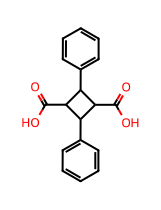
Find the number of optical isomers of the given compound.
- A3
- B2
- C6
- Dzero
Show answer and solution
(D) zero. The compound has 5 stereoisomers (cis/trans arrangements of the four groups). Four of them have a plane of symmetry and one has a centre of symmetry, so none is optically active.
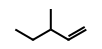
Which alkene shows both geometrical and optical isomerism?

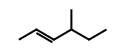
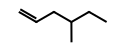
- A3-methylpent-1-ene
- B3-methylpent-2-ene
- C4-methylhex-2-ene
- D4-methylhex-1-ene
Show answer and solution
(C). (A) and (D) have a stereocentre but a terminal C=C; (B) has E/Z but no stereocentre.
X = number of dimethylcyclohexanes that are chiral. Find X.
Show answer and solution
X = 4: the two trans-1,2 enantiomers and the two trans-1,3 enantiomers. 1,1-, cis-1,2 (meso), cis-1,3 (meso) and both 1,4 isomers are achiral.
Four dimethylcyclohexenes: (1) cis-3,6-dimethylcyclohexene (2) trans-3,6-dimethylcyclohexene (3) 1,4-dimethylcyclohexene (4) trans-3,5-dimethylcyclohexene. X = number optically active; Y = total number of products when each is hydrogenated. Find X + Y.
Show answer and solution
Answer key: X = 3 (all except the cis-3,6 compound, which has a plane of symmetry), Y = 5 (1 + 1 + 2 + 1: compound 3 gives cis- and trans-1,4-dimethylcyclohexane). X + Y = 8.
How many pairs of diastereomers are possible for the given compound?
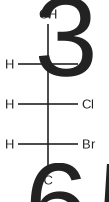
Show answer and solution
6. Three different stereocentres give = 8 stereoisomers. The given compound forms 7 pairs with the other 7: one is its enantiomer, the other 6 pairs are diastereomeric.
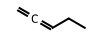
How many isomers of have 2 , 2 and 1 carbon?
Show answer and solution
4. The carbon must be the centre of an allene: penta-2,3-diene (chiral: 2 enantiomers), 3-methylbuta-1,2-diene (1) and penta-1,2-diene (1).