Nomenclature of Polyfunctional Compounds questions: Exercise: single choice
68 questions, each with the answer and a worked solution under it. Try each one before you open the answer.
Which does NOT have the formula ?
- Apropanoic acid
- Bmethyl ethanoate
- Cethyl ethanoate
- Dethyl methanoate
Show answer and solution
(C). Ethyl ethanoate is .
IUPAC name of :
- A3-bromo-4-formylpropan-2-one
- B4-formyl-3-bromopropan-2-one
- C2-bromo-3-oxobutanal
- D3-oxo-2-bromobutanal
Show answer and solution
(C). CHO is principal (C1); Br on C2, ketone (oxo) on C3; prefixes alphabetical.
Name :
- A5-chloro-2-hydroxy-4-oxohepta-2,5-dienoic acid
- B2-hydroxy-4-oxo-5-chlorohepta-2,5-dienoic acid
- C3-chloro-6-hydroxy-4-oxohepta-2,5-dienoic acid
- D3-chloro-4-oxo-6-hydroxyhepta-2,5-dienoic acid
Show answer and solution
(C). Number from COOH (C1): C2=C3 (Cl on C3), C4 oxo, C5=C6 (OH on C6), C7. Prefixes alphabetical: chloro, hydroxy, oxo.
Name :
- A2-chloro-1-hydroxybut-2-ene
- B3-chloro-4-hydroxybut-2-ene
- C2-chlorobut-2-en-1-ol
- D3-chlorobut-2-en-4-ol
Show answer and solution
(C). OH is the suffix and takes C1.
For : (1) it has an amide and a carboxyl group; (2) it is soluble in water; (3) its name is 2-aminoethanoic acid.
- A1, 2
- B1, 3
- C2, 3
- Dall
Show answer and solution
(C). The groups are an amine and a carboxylic acid (glycine), not an amide.
Name :
- A2-chloro-3-amino-4-oxobutanoic acid
- B3-amino-2-chloro-4-oxobutanoic acid
- C2-amino-3-carboxy-3-chloropropanal
- D2-amino-3-chloro-3-carboxypropanal
Show answer and solution
(B). COOH is C1; Cl on C2, on C3, CHO carbon (C4) is oxo. Alphabetical: amino, chloro, oxo.
Name :
- A1-chloropropan-3-al
- Bchloropropanal
- C3-chloropropanal
- D3-chloropropanol
Show answer and solution
(C).
Name :
- A3-hydroxy-4-aminopentanamide
- B4-amino-3-hydroxypentanamide
- C4-amino-3-hydroxy-4-methylbutanamide
- D3-hydroxy-4-amino-4-methylbutanamide
Show answer and solution
(B).
Name :
- A3-chlorobutyl butanoate
- B2-chlorobutyl butanoate
- Cbutyl 2-chlorobutanoate
- Dpropyl 4-chloropentanoate
Show answer and solution
(A). Acid part: butanoate. Alcohol part: , numbered from the O-bearing carbon: 3-chlorobutyl.
Name :
- A2,3-diamino-3-bromo-3-hydroxypentanoic acid
- B3,4-diamino-2-bromo-2-hydroxypentanoic acid
- C2-bromo-2-hydroxy-3,4-diaminopentanoic acid
- D2-bromo-2-hydroxy-3,4-diamino-4-methylbutanoic acid
Show answer and solution
(B). Multiplying prefixes (di) are ignored in alphabetical order: amino < bromo < hydroxy.
Which name-formula pair is correct?
- Adiol: HOOC-COOH
- Bmethyl 2-oxopent-3-enoate:
- C5-formylpent-2-ol:
- D3-carboxy-3-chlorobutan-2-ol:
Show answer and solution
(B). (A) is a diacid. (C) is 4-hydroxypentanal. (D) is 2-chloro-3-hydroxybutanoic acid.
Name :
- A3-amino-4-carboxybutan-2-one
- B3-amino-4-carboxybutan-2-al
- C2-amino-3-oxobutanoic acid
- D2-amino-3-methyl-3-oxopropanoic acid
Show answer and solution
(C).
Condensed formula of 3-oxopentanal:
- A
- B
- C
- D
Show answer and solution
(B). Write CHO, never COH.
Name :
- A3-fluoro-3-hydroxy-4,4-diaminopentanoic acid
- B4,4-diamino-3-fluoro-3-hydroxypentanoic acid
- C3-fluoro-3-hydroxy-4,4-diamino-4-methylbutanoic acid
- D4,4-diamino-3-fluoro-3-hydroxy-4-methylbutanoic acid
Show answer and solution
(B).
belongs to which homologous series?
- Aamines
- Balcohols
- Cketones
- Dcarboxylic acids
Show answer and solution
(D). The principal (highest-priority) group decides the class.
Condensed formula of 4-aminobutanamide:
- A
- B
- C
- D
Show answer and solution
(A).
Correct combination (IUPAC / trivial / use)?
- Apropan-1-ol / isopropyl alcohol / solvent
- Bethanoic acid / acetic acid / solvent
- Cmethanal / formaldehyde / production of polymers
- Dtrichloromethane / chloroform / fuel additive
Show answer and solution
Answer key: (B). (A) is wrong (isopropyl alcohol is propan-2-ol) and (D) is wrong (chloroform is not a fuel additive). Note: (C) is also correct as stated, since formaldehyde is a major monomer (phenol-formaldehyde and urea-formaldehyde resins), so this question has two defensible answers.
Ethanoic acid and methyl methanoate: (1) functional isomers, ; (2) different homologous series; (3) different chemical properties.
- A1, 2
- B1, 3
- C2, 3
- Dall
Show answer and solution
(D).
Which are functional group isomers of ? (1) methyl propanoate (2) 4-hydroxybutanal (3) butane-1,4-diol.
- A1, 2
- B1, 3
- C2, 3
- Dall
Show answer and solution
(A). Butane-1,4-diol is .
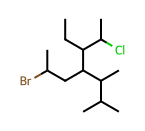
How many substituents are present?
- A3
- B4
- C5
- D6
Show answer and solution
(C) 5. Several 7-carbon chains exist. Choose the one with the most substituents: start at the methyl of the CHCl group and run to the far isopropyl end. Substituents: chloro, ethyl, 2-bromopropyl, and two methyls = 5.
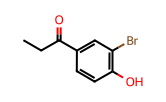
IUPAC name:
- Am-bromo-p-hydroxypropiophenone
- B2-bromo-4-propanoylphenol
- C1-(3-bromo-4-hydroxyphenyl)propan-1-one
- D2-hydroxy-5-propanoylbromobenzene
Show answer and solution
(C). Ketone outranks the phenol OH, so the ketone gives the suffix.
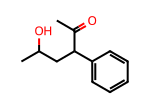
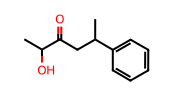
Which is 5-hydroxy-2-phenylhexan-3-one?
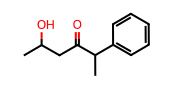
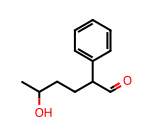
Show answer and solution
(C). C1 , C2 CH(Ph), C3 C=O, C4 , C5 CH(OH), C6 .
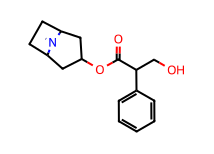
Which group is NOT present in atropine?
- Aamine
- Bphenol
- Cester
- Dbenzene ring
Show answer and solution
(B). Atropine has a 3 amine, an ester, a benzene ring and a primary alcohol, but no phenol.
IUPAC name of :
- A4-hydroxyhex-1-en-6-al
- B1-oxohex-5-en-3-ol
- C3-hydroxyhex-5-enal
- D6-oxohex-1-en-4-ol
Show answer and solution
(C). CHO is principal (C1).
IUPAC name of benzyl alcohol:
- Aphenol
- Bhydroxymethylbenzene
- Cbenzenol
- Dphenylmethanol.
Show answer and solution
(D) phenylmethanol.
IUPAC name of TNT:
- Atrinitrotoluene
- B1,2,3-trinitrotoluene
- C2,4,6-trinitrotoluene
- D2-methyl-1,3,5-trinitrotoluene.
Show answer and solution
(C) 2,4,6-trinitrotoluene (fully systematic: 2-methyl-1,3,5-trinitrobenzene).
IUPAC name of laughing gas:
- Anitrogen oxide
- Bnitrogen dioxide
- Cdinitrogen oxide
- Dnitrous oxide.
Show answer and solution
the original question's key gives (D) nitrous oxide, which is the common name; the systematic name of is dinitrogen oxide, (C).
The compound below is called churchane. What is its double bond equivalent?

- A4
- B5
- C6
- D7
Show answer and solution
(C) 6. As drawn the cage has 11 C and 16 C-C bonds, formula . A saturated cage has no bonds, so DBE = number of rings = bonds - atoms + 1 = 16 - 11 + 1 = 6. Check: (2 x 11 + 2 - 12)/2 = 6.
IUPAC name of natrium:
- Asodium
- Bnitride
- Cnatride
- Dsodide.
Show answer and solution
(A).
"penguinone" (below):
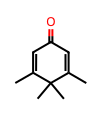
- A6-oxo-2,3,3,4-tetramethylcyclohexa-1,4-diene
- B3,4,4,5-tetramethylcyclohexa-2,5-dien-1-one
- C6-formyl-2,3,3,4-tetramethylcyclohexa-1,4-diene
- D2,3,3,4-tetramethylcyclohexa-1,4-dien-6-one.
Show answer and solution
(B): the ketone is the suffix and takes C1.
IUPAC name of "unsymmetric butylene":
- A1-butene
- B2-butene
- C2-methylpropene
- D2-methylbutene.
Show answer and solution
Answer key (A) but-1-ene (the C=C sits unsymmetrically in the chain).
correct acid-source pair:
- Aformic acid, vinegar
- Bacetic acid, ant
- Cbutyric acid, butter
- Dstearic acid, goat.
Show answer and solution
(C).
IUPAC name:
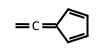
- A5-ethenylidenecyclopenta-1,3-diene
- B1,3-cyclopentadiene-5-ethenyl ketene
- Ccyclopentyl-2,4-dienylidene ethene
- D1-ethenylidenecyclopenta-2,4-diene
Show answer and solution
(A). The ring C=C bonds get 1 and 3; the exocyclic ethenylidene is on C5.
full form of DEAD (below)?
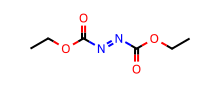
- Adiethyl azodicarboxylic acid
- Bdiethyl azodicarboxylic anhydride
- Cdiethyl azodicarboxylate
- Ddiethyl azodione.
Show answer and solution
(C).
IUPAC name of paracetamol:
- AN-(4-hydroxyphenyl)acetamide
- BN-phenylacetamide
- CN-phenolethanamide
- DN-(4-hydroxyphenyl)ethanamide
Show answer and solution
(D) (the original question's key); (A) uses the retained name acetamide and is the same compound.
IUPAC name of acetophenone:
- Abenzophenone
- B1,1-biphenylmethanone
- Cbenzene methyl methanone
- D1-phenylethanone.
Show answer and solution
(D).
the original question omits the drawing for this question; the options are
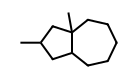
- A1,3-,
- B1,3-[5.3.1],
- C1,8-,
- D1,9-dimethylbicyclo[5.3.0]decane. The structure of the keyed answer is shown.
Show answer and solution
Answer key (D). Numbering a bicyclo system starts at a bridgehead (C1), runs round the largest bridge (C2-C6) to the other bridgehead (C7), then the next bridge (C8-C10).
Which is an allylic alcohol?

- A
- B
- C
- D.
Show answer and solution
Answer key (B); note that (C), crotyl alcohol, is also allylic (OH on the carbon next to C=C).
number of six-membered rings in adamantane:
- A4
- B5
- C6
- D7.
Show answer and solution
(A) 4.
which has no isomers?
- A
- B
- C
- D.
Show answer and solution
(D) propane. ( has propene and cyclopropane.)
general formula of non-cyclic alkenes:
- A
- B
- C
- D
Show answer and solution
(B).
IUPAC name:
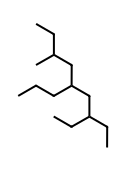
- A7-ethyl-3-methyl-5-propylnonane
- B6-ethyl-4-(2-methylbutyl)
- C3-ethyl-7-methyl-5-propylnonane
- D3-methyl-5-(2-ethylbutyl)octane
Show answer and solution
(C). Locants {3,5,7} from either end; on the tie, ethyl (cited first) takes 3.
IUPAC name:

- Abicyclo[4.1.0]hepta-1,2,4-triene
- Bbicyclo[0.1.4]hepta-1,2,4-triene
- Cbicyclo[4.1]hepta-1,2,4-triene
- Dbicyclo[1.4]hepta-1,2,4-triene
Show answer and solution
(A), better written bicyclo[4.1.0]hepta-1(6),2,4-triene. Bridge sizes go in decreasing order with the zero bridge last.
IUPAC name of ethyl formate:
- Aethyl ethanoate
- Bethyl methanoate
- Cmethyl methanoate
- Dmethyl ethanoate.
Show answer and solution
(B).
phenyl acetate:
- Aphenyl ethanoate
- Bphenyl 1-phenylmethanoate
- Cphenyl methanoate
- D1-phenylethanone.
Show answer and solution
(A).
carbons in the longest chain (IUPAC)?
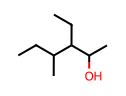
- A4
- B5
- C6
- D7
Show answer and solution
(C) 6: the chain must include the C-OH carbon; the best one runs from the next to C-OH through to the far ethyl end (3-ethyl-4-methylhexan-2-ol).
IUPAC name:
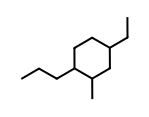
- A5-ethyl-1-methyl-2-propylcyclohexane
- B1-ethyl-3-methyl-4-propylcyclohexane
- C4-ethyl-2-methyl-1-propylcyclohexane
- D4-ethyl-1-methyl-3-propylcyclohexane
Show answer and solution
(C). {1,2,4} is the lowest set.
common name of (cyclohexyl):
- Acyclohexyl sec-pentyl ether
- Bcyclohexyl isopentyl ether
- Ccyclohexyl isobutyl ether
- Dcyclohexyl sec-butyl ether.
Show answer and solution
(B).
IUPAC name:
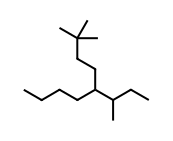
- A4-butyl-3,7,7-trimethyloctane
- B5-butyl-2,2,6-trimethyloctane
- C6-methyl-5-(3,3-dimethylbutyl)octane
- D2,2-dimethyl-5-(1-methylpropyl)nonane
Show answer and solution
(D): the longest chain is 9 C (butyl + branch carbon + ).
number of OH groups in vitamin C:
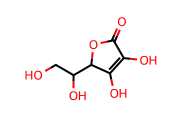
- A2
- B3
- C4
- D5.
Show answer and solution
(C) 4.
which name is correctly written?
- Atrans-1-tert-butylpropene
- B6-methylcycloheptene
- C3-butene
- D(Z)-2-hexene.
Show answer and solution
(D): (A) should be 4,4-dimethylpent-2-ene, (B) 3-methylcycloheptene, (C) but-1-ene.
P = bicyclo[2.1.1]hexane, Q = bicyclo[3.1.0]hexane: which is fused, which bridged?
Show answer and solution
Q is fused (a zero bridge), P is bridged: option (C).
which formula can contain a benzene ring?
- A
- B
- C
- D
Show answer and solution
(B): DBE , enough for a ring plus a CC; (A) and (D) have DBE 3; has too few carbons.
valproic acid, :
- Aheptane-4-carboxylic acid
- B2-propylpentanoic acid
- C2-propylpentanecarboxylic acid
- Dheptane-4-oic acid.
Show answer and solution
(B).
IUPAC name:
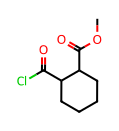
- Amethyl 2-chloroformyl-1-cyclohexanecarboxylate
- B2-methoxycarbonylcyclohexanecarbonyl chloride
- Cmethyl 2-chloroformyl-1-cyclohexanoate
- D2-methoxycarbonylcyclohexanonyl chloride.
Show answer and solution
(A): the ester outranks the acid chloride, so COOMe is the suffix and COCl becomes a prefix (chlorocarbonyl, older: chloroformyl).
ratio of to bonds in benzene:
- A1:2
- B1:3
- C1:4
- D4:1
Show answer and solution
(C): 3 and 12 (6 C-C + 6 C-H).
common name of the compound below.
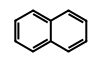
Show answer and solution
(A).
name of :
- AN-ethylethanamide
- BN-methylethanamide
- CN,N-diethylethanamide
- DN,N-dimethylethanamide.
Show answer and solution
(D).
isoprene:
- A2-methylbuta-1,3-diene
- B2,3-dimethylbuta-1,3-diene
- Cmethylbuta-1,3-diene
- D2-methylbut-1-ene.
Show answer and solution
(A).
name of : (A) 2-methyl-4-methylidenehex-2-ene (B) 4-ethyl-2-methylpenta-1,3-diene (C) 2-ethyl-4-methylpenta-1,3-diene (D) 4-methyl-2-methylidenehex-2-ene (A) naphthalene (B) anthracene (C) phenanthracene (D) phenanthrene
Show answer and solution
(C): the chain holding both C=C is five carbons; end is C1. (Under the 2013 rules the longest chain is chosen first, giving option (A)-type names; the original question follows the older rule.)
Which ring carbon (a-g) gets number 1?
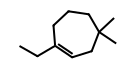
- Aa
- Bb
- Cc
- Dg
Show answer and solution
(C) c. The C=C must be C1-C2. Starting at c (ethyl) and going through b, a to g gives 1-ethyl-4,4-dimethylcyclohept-1-ene, locants {1,4,4}; the alternative start gives higher locants.
(meta):
- Ap-nitrophenol
- Bm-nitrophenol
- Co-nitrophenol
- Dm-nitrophenyl.
Show answer and solution
(B).
:
- Amethyl phenyl ether
- Bbenzyl methyl ether
- Cdimethyl phenyl ether
- Dmethoxybenzene.
Show answer and solution
(B).
oxiranyl-:
- A1,2-epoxy-3-propanol
- B1,2-oxa-3-propanol
- C2,3-epoxy-1-propanol
- D2,3-epoxy allyl alcohol.
Show answer and solution
(C) (oxiran-2-ylmethanol).
:
- A3,4-dimethylbut-2-en-4-ol
- B3-methylpent-2-en-4-ol
- C3-methylpent-3-en-2-ol
- D1,2-dimethylbut-2-en-1-ol.
Show answer and solution
(C).
name of the compound below.
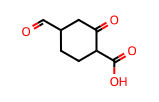
Show answer and solution
(C).
:
- Ahydroxypentenoic acid
- B4-hydroxy-3-pentenoic acid
- C4-hydroxy-4-pentenoic acid
- D4-hydroxy-4-methyl-3-enepentenoic acid.
Show answer and solution
(B) (4-hydroxypent-3-enoic acid).
: (A) 2-hydroxypropanoic acid (B) 2-methyl-2-hydroxyethanoic acid (C) propanoic acid (D) 2-carboxyethanol Q66 options: (A) 5-carboxy-3-oxocyclohexanecarboxaldehyde (B) 2-carboxy-5-formylcyclohexane (C) 4-formyl-2-oxocyclohexanecarboxylic acid (D) 4-carboxy-3-oxocyclohexanal
Show answer and solution
(A) (lactic acid). The original question prints Q68 with in place of , a misprint.