Bond length
Bond Length and Bond Energy from Resonance notes: Bond length, explained step by step, with 2 worked examples.
Resonance mixes single and double bond character. In a conjugated system, a "double" bond becomes a little longer and a "single" bond a little shorter.
- Bond length falls as bond order rises: single > partial double > double > partial triple > triple.
- Double-bond character (DBC) . Single-bond character (SBC) bond length.
- Higher s character in the bonded carbon also shortens a bond: C()-H < C()-H < C()-H.
| Bond | Typical length (pm) |
|---|---|
| C-C (ethane) | 154 |
| C-C in buta-1,3-diene (central bond) | 147 |
| C-C in benzene | 139 |
| C=C (ethene) | 134 |
| CC (ethyne) | 120 |
| C-N (methylamine) | 147 |
| C-N (aniline) | 140 |
| C-N (amide) | 135 |
| C-O (methanol) | 143 |
| C-O (carboxylate, average) | 127 |
| C=O (formaldehyde) | 121 |
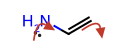

Rank the C-N bond length: (a) , (b) , (c) , (d) , (e) p-nitroaniline.
Show answer and solution
Longest has the least double-bond character. (a) no resonance. (b) and (c) one-way delocalisation of the N lone pair; in aniline it is shared with a whole ring, so each C-N gains a little less DBC than in vinylamine. (e) the para pulls the lone pair strongly (push-pull), so C-N is shorter than in aniline. (d) amide: strong delocalisation into C=O. Order of length: a > c > b > e d. (Exact order between b, d and e depends on data; a is clearly longest and the amide, about 135 pm, among the shortest.)
In (methanesulfonate) compare the three S-O bonds.
Show answer and solution
The negative charge is shared by three equivalent contributors, so all three S-O bonds are the same length. The same holds for the C-O bonds in carbonate and the N-O bonds in nitrate.
Cross conjugation vs linear conjugation
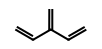
In a linear (extended) conjugated chain, every bond can talk to every other. In a cross-conjugated system, two units are each conjugated with a third but not with each other (as in 3-methylenepenta-1,4-diene or benzophenone). A bond in a cross-conjugated branch gains less single/double mixing than a bond in a linear chain.