Aromaticity questions: Subjective
10 questions, each with the answer and a worked solution under it. Try each one before you open the answer.
Which of these compounds are aromatic? Justify with electron counting. You may treat each ring separately or several rings together.

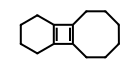

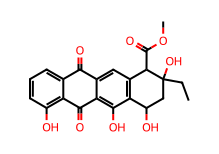
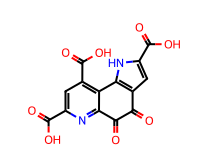
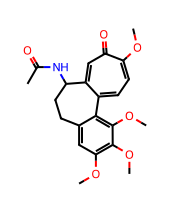
Show answer and solution
Rules: count a ring heteroatom lone pair only if it sits in a p orbital; never count electrons outside the ring (an exocyclic C=O or C= bond, or a lone pair in an orbital in the ring plane).
- (a) two ring C=C (4 e) plus one O lone pair (2 e) = 6 e; the exocyclic C= is not counted: aromatic (in its pyrylium-like polar form).
- (b) the four-membered ring has 4 e (cyclobutadiene): not aromatic (antiaromatic).
- (c) tetrazolide anion: the charge sits in an in-plane lone pair and is not counted; two C=N/N=N bonds (4 e) + one N lone pair in a p orbital (2 e) = 6: aromatic.
- (d) aklavinone: two benzene rings; one saturated ring; the quinone ring cannot reach 6 e, so it is not aromatic.
- (e) methoxatin: the pyrrole ring (N lone pair counted) and the pyridine ring (N lone pair not counted) are aromatic; the 1,2-dione ring is not.
- (f) colchicine: one benzene ring and a tropolone ring that is aromatic (6 e, the C=O not counted).
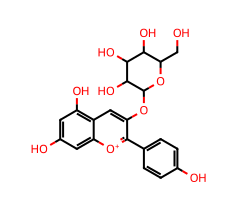
- (g) callistephin: a phenol ring plus a bicyclic oxygen cation (benzopyrylium), aromatic like naphthalene (10 e) or as two fused 6-electron rings.
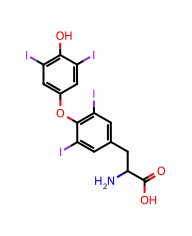
Spot the aromatic rings in these compounds and give reasons. Why the name "tetracycline" for aklavinone's class?
(aklavinone, colchicine, callistephin and methoxatin: as drawn in S20.1)
Show answer and solution
Thyroxine: two benzene rings. Aklavinone: two aromatic rings; one saturated ring; the quinone ring is not aromatic. "Tetracycline" means four rings. Colchicine, callistephin, methoxatin: as in S20.1.
Why does azulene have an unexpectedly high dipole moment?
Show answer and solution
electron density moves from the 7-ring to the 5-ring, giving a tropylium cation fused to a cyclopentadienide anion; both are aromatic, so this polar form contributes strongly (about 1.0 D).
Compare dipole moments: (a) p-toluidine / p-anisidine (b) vinyl bromide / ethyl bromide (c) 2,3-diphenylcyclopropenone / acetophenone (d) / (e) p-chlorophenol / p-fluorophenol (f) tropolone / 2-hydroxytropolone
Show answer and solution
(answers): (a) p-anisidine > p-toluidine (b) ethyl bromide > vinyl bromide: in vinyl bromide +M of Br opposes -I (c) diphenylcyclopropenone > acetophenone: aromatic cyclopropenium form (d) (1.87 D) > (1.85 D): the longer C-Cl bond outweighs the smaller charge (e) original: p-chlorophenol > p-fluorophenol (the original question's d-orbital argument is outdated; the simpler reason is that F's +M partly cancels its -I, and F withdraws less overall than expected) (f) 2-hydroxytropolone > tropolone: both gain an aromatic tropylium form, and the extra OH helps it by H-bonding.
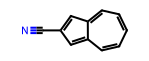
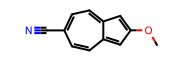
Compare the dipole moments of the following compounds, with reasons.


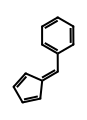

Show answer and solution
(a) (i) > (ii). In azulene's polar form the 7-ring is electron-poor (+) and the 5-ring electron-rich (-). In (i) the CN acceptor sits on the 5-ring and adds to that polarity. In (ii) the OMe donor is on the 5-ring and the CN acceptor on the 7-ring, both working against it. (b) (iv) > (iii): Br in (iv) can leave as bromide to give an aromatic tropylium-like polar form; (iii) has no such form. (c) (v) > (vi): the fulvene polar form makes an aromatic cyclopentadienide ring with a benzylic cation next to the phenyl ring, a larger charge separation than in azulene.
Which member of each pair has the higher resonance energy? Justify. (a) anthracene / phenanthrene (b) ammonium acetate / acetamide (c) cyclooctatetraene / styrene (d) benzene / hexamethylbenzene (e) p-benzoquinone / benzaldehyde (f) furan / thiophene (g) the pair below.


Show answer and solution
(a) phenanthrene (92 vs 84 kcal/mol) (b) original: acetamide (c) styrene (COT is non-planar) (d) original: hexamethylbenzene (methyl hyperconjugation adds a little) (e) benzaldehyde (p-benzoquinone is cross-conjugated, not aromatic) (f) thiophene (g) tropolone (aromatic tropylium-type form, plus an intramolecular H-bond).
Using aromaticity, explain why A and B are different compounds but C and D are identical.
Show answer and solution
cyclobutadiene is antiaromatic and has localised (rectangular) bonds, so A (D atoms on a C=C) and B (D atoms on a C-C) are different molecules. Benzene's electrons are fully delocalised, so C and D are only two drawings of one molecule.
Account for: (a) the barrier to rotation about the central C=C of the compound below is only about 14 kcal/mol; (b) hydrocarbon A (pK about 14) is much more acidic than its isomer B (pK about 22); both are tricyclic 5-7-5 hydrocarbons with one ring : in A the ring is fused to the seven-membered ring, in B to a five-membered ring; (c) cyclopentadienone is kinetically unstable.


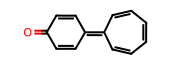


Show answer and solution
(a) in the polar form the seven-membered ring becomes a tropylium cation and the other ring a phenoxide, both aromatic; the central bond becomes nearly single, so rotation is easy. (b) the conjugate base of A puts the charge in a ring that completes an aromatic cyclopentadienide fused to an azulene-type system; B's anion is less well delocalised. (c) its polar form puts a 4 e (antiaromatic) cation in the ring, and it dimerises quickly by Diels-Alder.
In what direction is the dipole moment in (a) fulvene (b) calicene? Explain.
Show answer and solution
(a) fulvene: from the exocyclic toward the ring (the ring is the negative end, cyclopentadienide-like). (b) calicene: from the three-membered ring (positive, cyclopropenium) toward the five-membered ring (negative).
Why is [18]annulene more stable than [14]annulene?
Show answer and solution
[18]annulene is large enough to be nearly planar without H-H clashes, so its 18 e are fully delocalised. In [14]annulene the inner H atoms clash and the ring twists, reducing overlap.