Aromaticity questions: Unsolved examples
7 questions, each with the answer and a worked solution under it. Try each one before you open the answer.
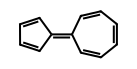
The hydrocarbon below (sesquifulvalene) has an unusually large dipole moment. Explain why.
Show answer and solution
in its polar form the seven-membered ring is a tropylium cation and the five-membered ring a cyclopentadienide anion; both aromatic, so the zwitterionic form contributes strongly.
Between 1865 and 1890, other structures were proposed for benzene, such as Dewar benzene and Ladenburg benzene. Considering what 19th-century chemists knew about benzene, which is the better proposal? Why?


Show answer and solution
original answer: Dewar. Note: chemists then knew that benzene gives one monosubstituted and three disubstituted derivatives and does not add easily. Dewar benzene has two kinds of H (it would give two monobromo isomers) and two reactive C=C. Prismane has six equivalent H and no C=C, so Ladenburg's structure fits those facts better (it fails only later tests, such as optical activity of some disubstituted isomers).
Explain this reaction, which gives the pentalene dianion:


Show answer and solution
the dihydropentalene loses two C-H protons; the dianion has 10 e over the bicyclic perimeter (two fused cyclopentadienide units): aromatic.
How would you convert each compound to an aromatic species?
Show answer and solution
(reagents): (a) NaH (cyclopentadienide) (b) HI (loses water: tropylium iodide) (c) (cyclopropenyl cation) (d) NaOH (gives pyrrole) (e) NaH (cyclononatetraenide, 10 e) (f) (pyrylium) (g) 2 Na (COT dianion, 10 e).
Is either of these ions aromatic: the cyclononatetraenyl cation or the cyclononatetraenide anion?


Show answer and solution
the anion (10 e) is aromatic; the cation (8) is not.
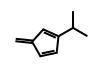
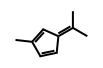
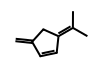
One of these hydrocarbons is much more acidic than the others. Explain why.

Show answer and solution
(4) is the acid: it is the only one with an ring . Losing a proton there gives a fully conjugated anion whose charge can be drawn on the ring carbons, giving cyclopentadienide (aromatic) character. (1) to (3) are fulvenes with no ring C-H.
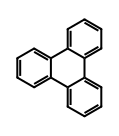
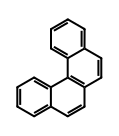
Explain why compound A (triphenylene) is much more stable than compound B.
Show answer and solution
triphenylene can be drawn with three separate aromatic sextets (Clar's rule); the central ring has no double bonds of its own. This gives it the largest resonance energy of the isomers.