Aromaticity questions: Solved examples
22 questions, each with the answer and a worked solution under it. Try each one before you open the answer.
Which is more stable, and why?


Show answer and solution
Benzene is more stable. It is aromatic: a planar, cyclic, fully conjugated ring with 6 electrons (4n + 2, n = 1). Delocalisation round the ring lowers the energy. The open-chain triene has no such cyclic delocalisation.
Which is more stable, and why?


Show answer and solution
Buta-1,3-diene is more stable. Cyclobutadiene meets the first three criteria (cyclic, planar, a continuous ring of overlapping p orbitals), but it has 4 electrons (4n, n = 1). Delocalising them round the ring raises the electronic energy, so cyclobutadiene is less stable than its open-chain counterpart: it is antiaromatic.
Does the MO energy diagram of (planar) cyclooctatetraene look like a particularly stable or unstable configuration? Explain.

Show answer and solution
Unstable. Polygon rule: draw the octagon with one vertex down; the vertices give the MO levels. For 8 p orbitals: 1 lowest bonding MO, 2 degenerate bonding MOs, 2 degenerate non-bonding MOs (on the middle line), 2 degenerate antibonding MOs and 1 highest MO. The 8 electrons fill the three bonding MOs (6 e) and put 1 electron in each non-bonding MO (2 e, unpaired). A half-filled degenerate pair is the antiaromatic pattern, like cyclobutadiene (benzene instead has all 6 e paired in bonding MOs). Real cyclooctatetraene avoids this by taking a non-planar tub shape, which makes it non-aromatic.
Aromatic, antiaromatic or non-aromatic?


Show answer and solution
(a) pyrrole: 6 e, aromatic (b) 6, aromatic (c) 4, antiaromatic (d) 2H-imidazole: , non-aromatic (e) imidazole: 6, aromatic (f) indole: 10, aromatic (g) cyclobutadiene dication: 2, aromatic (h) cyclobutadiene dianion: 6, aromatic (i) 1,3-dioxolylium cation: 6, aromatic.
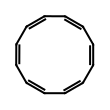
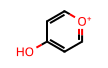
Assume each is planar. Aromatic, antiaromatic or non-aromatic?


Show answer and solution
(a) 12 e: antiaromatic if planar (b) 6: aromatic (c) original: antiaromatic. Note: a nitrogen with four bonds has no free p orbital, so the ring is not fully conjugated; the correct label is non-aromatic. (d) 8 e (O and NH lone pairs + two bonds): antiaromatic if planar (e) 6: aromatic.
What do you get when you remove , or from the of cyclopenta-1,3-diene and of cyclohepta-1,3,5-triene? Which products are aromatic?
Show answer and solution
Cyclopentadiene: cation 4 e, radical 5, anion 6 (aromatic). Cycloheptatriene: cation 6 (aromatic), radical 7, anion 8. So NaOH deprotonates cyclopentadiene, and turns cycloheptatriene into tropylium bromide.


X = number of these reactions that give an aromatic product. Find X - 4.


Show answer and solution
Answer key: aromatic products in (b), (e), (f), (g), (h), (i), (j), (k), (l), (m), (n), so X = 11 and X - 4 = 7. Main cases: (b) cyclopropenyl cation, 2 e; (f) tropylium; (g) COT dianion, 10 e; (m) protonated tropone (hydroxytropylium); (n) cyclobutadiene dianion, 6 e. (a) gives a non-aromatic cation; (c) a vinyl cation; (d) the antiaromatic cyclopentadienyl cation.
Why does cyclobutadiene dimerise even at low temperature, and why does it react easily with active metals?
Show answer and solution
It is antiaromatic (4 e, planar), so it is very unstable. One molecule acts as diene and one as dienophile (Diels-Alder), giving a non-aromatic dimer. With 2 Na it takes two electrons and becomes the 6 e aromatic dianion. Both reactions remove the antiaromaticity.
Use Huckel's rule.




Show answer and solution
(no. of e, nature) 1: 2, non-aromatic ( C) 2: 4, antiaromatic 3: 2, aromatic 4: 2, aromatic 5: 6, aromatic 6: 2, non-aromatic 7: 4, non-aromatic 8: 6, aromatic 9: 4, antiaromatic 10: 4, antiaromatic 11: 4, antiaromatic 12: 6, aromatic 13: 4, non-aromatic (not cyclic) 14: 2-pyrone, 6 (counting one ring O lone pair), aromatic in its polar form.
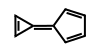
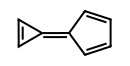
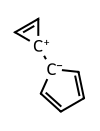
(a) 7-bromo-1,2,3,4,5,6,7-heptacyclopropylcycloheptatriene ionises. Is Br lost as or ? (b) Why does calicene (below) have a high dipole moment?
Show answer and solution
(a) As : the ring becomes an aromatic tropylium ion (the cyclopropyl groups also donate electrons to it). (b) In its polar contributor the three-membered ring is a cyclopropenyl cation (2 e) and the five-membered ring a cyclopentadienyl anion (6 e). Both rings become aromatic, so this form contributes a lot.
Compare the rates of reaction with of (a) 5-iodocyclopenta-1,3-diene and (b) 7-iodocyclohepta-1,3,5-triene.


Show answer and solution
(b) is much faster. pulls off iodide and the rate follows the stability of the cation formed: (b) gives the aromatic tropylium ion, (a) the antiaromatic cyclopentadienyl cation.
Cycloheptatrienone (tropone) is stable, but cyclopentadienone cannot be isolated. Explain using the polarity of C=O. (The original question labels tropone "cyclopropanone", a misprint.)


Show answer and solution
Write the polar form . For tropone the ring becomes a 6 e tropylium ion (aromatic), so the polar form helps a lot. For cyclopentadienone the ring becomes a 4 e cyclopentadienyl cation (antiaromatic), so the C=O polarity actually destabilises the molecule.
Which is most stable: the cyclononatetraenyl cation, radical or anion? How could you make an aromatic species from cyclonona-1,3,5,7-tetraene?
Show answer and solution
Cation 8 e, radical 9, anion 10. The anion (10 = 4n + 2, n = 2) is aromatic and most stable. Treat the tetraene with a strong base such as to remove the proton.
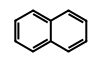
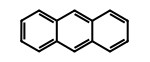
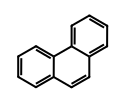
The first four benzene-based aromatic hydrocarbons have these resonance energies: benzene 36, naphthalene 61, anthracene 84, phenanthrene 92 kcal/mol. Phenanthrene has five Kekule structures, and one of its bonds adds just like an alkene. Which bond, and why?
Show answer and solution
The C9-C10 bond. It is a double bond in four of the five Kekule structures, so it has the most double-bond character. Addition there leaves two separate benzene rings (2 x 36 = 72), so it costs only 92 - 72 = 20 kcal/mol of resonance energy. Addition in an outer ring would leave a naphthalene and cost 92 - 61 = 31 kcal/mol.
From the data below, calculate the resonance energy of the cyclopentadienyl cation.


Show answer and solution
One C=C next to the cation (an allyl-type cation) releases 14.58 kcal/mol on hydrogenation, so two such C=C are expected to release 2 x 14.58 = 29.16 kcal/mol. The cyclopentadienyl cation actually releases 72.91 kcal/mol, so it is 72.91 - 29.16 = 43.75 kcal/mol higher in energy than expected. Resonance energy = -43.75 kcal/mol (negative): the cation is antiaromatic.
Heats of hydrogenation (kJ/mol): cyclohexene -120, cyclohexa-1,4-diene -240, cyclohexa-1,3-diene -232, benzene -208. Find for: (a) benzene + to cyclohexa-1,4-diene (b) benzene + 2 to cyclohexene (c) cyclohexa-1,3-diene + to cyclohexene.
Show answer and solution
Use Hess's law with cyclohexane as the common product. (a) +32 kJ/mol (uphill: aromaticity is lost) (b) -88 kJ/mol (c) -112 kJ/mol.
Sketch the MO diagram for the cyclopentadienyl cation and use it to decide whether it is aromatic or antiaromatic. Is this consistent with its resonance energy?
Show answer and solution
Polygon rule: a pentagon with one vertex down gives 1 low bonding MO, a degenerate pair of bonding MOs, and a degenerate pair of antibonding MOs. The cation has 4 electrons: 2 fill the lowest MO and the other 2 go one each into the degenerate pair (unpaired). This half-filled pair marks it as antiaromatic. It agrees with the negative resonance energy (-43.75 kcal/mol) found in the previous example.
(i) The compound below (a central benzene ring fused to three benzocyclobutadiene units) is hydrogenated with 3 /Pd. x = number of products, counting stereoisomers.
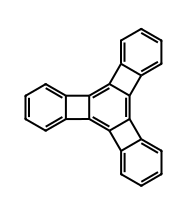
(ii) y = number of meso isomers formed when two H atoms of anthracene are replaced by Br. Find x + y.
Show answer and solution
2. (i) The three add to the central ring, which removes all the antiaromatic cyclobutadiene rings and leaves three benzene rings. The new H atoms can be all on one side or two on one side: x = 2. (ii) Dibromoanthracenes have no stereocentres, so y = 0.
(a) 3-Chlorocyclopropene with gives AgCl and a stable solution. What is the product? (b) When 3-chloro-1,2,3-tricyclopropylcyclopropene ionises, is or formed?
Show answer and solution
(a) Cyclopropenyl tetrafluoroborate: 2 e, aromatic (n = 0), three equivalent contributors. (b) , leaving the aromatic tricyclopropylcyclopropenyl cation (one of the most stable carbocations known).
How many of these are aromatic?


Show answer and solution
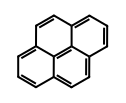
4: (a), (g), and the "quasi-aromatic" (d) and (h), whose polar forms contain aromatic rings. (b) is antiaromatic (4 e); (c), (e), (f) are non-aromatic.
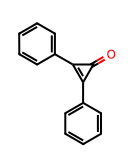
(a) Which has the larger dipole moment: diphenylcyclopropenone or benzophenone? (b) Order of reaction rate with : (I) 3-chlorocyclopropene (II) chlorocyclopropane (III) 5-chlorocyclopentadiene.
- AI > III > II
- BII > III > I
- CI > II > III
- DIII > I > II
Show answer and solution
(a) Diphenylcyclopropenone: its form has an aromatic cyclopropenyl cation ring. (b) (C): I gives an aromatic cation, II a non-aromatic one, III an antiaromatic one.
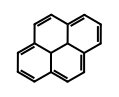
Comment on the nature (aromatic or not) of the compounds below.


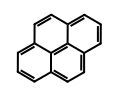
Show answer and solution
(1) Aromatic: count 6 ring e (the exocyclic C=O is not counted). (2) Non-aromatic: tub-shaped. (3), (4) Aromatic by the perimeter rule: count the 14 e of the perimeter; an internal bond is not counted.