Isomerism (Structural) questions: Questions from the chapter
26 questions, each with the answer and a worked solution under it. Try each one before you open the answer.
how many terminal alkynes ?
Show answer and solution
2: pent-1-yne, 3-methylbut-1-yne.
how many terminal alkynes ?
Show answer and solution
4: hex-1-yne, 3-methylpent-1-yne, 4-methylpent-1-yne, 3,3-dimethylbut-1-yne.
which are correct? (1) position isomers differ only in the position of the functional group(s) (2) structural isomers have the same relative molecular mass (3) functional group isomers belong to different homologous series.
- A1, 2
- B1, 3
- C2, 3
- Dall.
Show answer and solution
(C): (1) is too narrow, since position isomers may also differ in a substituent or multiple bond.
butanoic acid is reduced to a primary alcohol. Which is its position isomer?
- A
- B
- C
- D
Show answer and solution
(D) butan-2-ol.
structural isomers of ?
Show answer and solution
5 (3 alkenes + cyclobutane + methylcyclopropane).
which are structural isomers of : (1) 2-methylbut-2-ene (2) 3-methylbut-1-ene (3) pent-1-ene?
Show answer and solution
all three.
structural isomers of ?
Show answer and solution
4 (1,1-; 1,2-; 1,3-; 2,2-).
which are structural isomers of : (1) 2-methylbutanal (2) propyl ethanoate (3) pentanal?
- A1, 2
- B1, 3
- C2, 3
- Dall
Show answer and solution
the original question's key says (D), but propyl ethanoate is . The correct answer is (B).
Q9: how many dibromophenols? (A) 8 (B) 7 (C) 6 (D) 5. Q10: how many alcohols (structural only)? Q11: how many isomers have a five-carbon parent chain? Q12: which is NOT an isomer of the others? Q13: structural isomers of ?
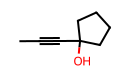
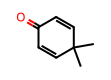
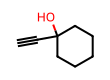
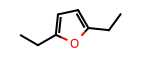
Show answer and solution
Q9 6. Q10 8: pentan-1-, 2-, 3-ol; 3-methylbutan-1-ol, 3-methylbutan-2-ol, 2-methylbutan-2-ol, 2-methylbutan-1-ol; 2,2-dimethylpropan-1-ol. Q11 5: 3-ethylpentane and 2,2-, 2,3-, 2,4-, 3,3-dimethylpentane. Q12 (B): (DBE 4); the others are (DBE 3). Q13 5.

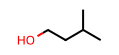


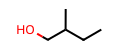

which pair are NOT structural isomers?
- Abutane / isobutane
- Bacetone / cyclopropanol
- C3-methylcyclobutene / but-2-yne
- Dmethyl propanoate / but-2-ene-1,4-diol.
Show answer and solution
(C): vs .
how many alkynes ?
Show answer and solution
3: pent-1-yne, pent-2-yne, 3-methylbut-1-yne.
structural isomers of ?
Show answer and solution
8.
replacing one H by D gives how many structural isomers for but-1-ene and for buta-1,3-diene?
- A2, 0
- B4, 2
- C2, 4
- D4, 4.
Show answer and solution
(B): but-1-ene has four different C environments (C1 to C4); butadiene two (C1, C2).
number of position isomers of 1-bromo-1-chlorocyclohexane (excluding itself):
- A6
- B5
- C4
- D3.
Show answer and solution
(D) 3: 1-bromo-2-, 1-bromo-3-, 1-bromo-4-chlorocyclohexane.
a = structural isomers of , b = of ; a + b = ?
Show answer and solution
27 (18 + 9).
structural isomers of ?
Show answer and solution
9 (see the worked example in the notes).
of ?
- A7
- B8
- C9
- D10.
Show answer and solution
the original question's key gives (B) 8, but the count is 9 (C): six on the butane chain (1,1; 1,2; 1,3; 1,4; 2,2; 2,3) and three on isobutane (1,1; 1,2; 1,3).
of ?
- A5
- B7
- C8
- D12.
Show answer and solution
12 (D): 8 open-chain chlorobutenes and 4 cyclic (chlorocyclobutane, 1-chloro-1-methyl-, 1-chloro-2-methyl- and (chloromethyl)cyclopropane).
of ?
Show answer and solution
3.
two isomers of a saturated hydrocarbon:
- Asame structure
- Bdifferent composition
- Csame molecular formula
- Dall
Show answer and solution
(C).
Q25: isomers of ? Q26: of ? (A) 4 (B) 5 (C) 6 (D) 9. Q27: number of six-membered aromatic compounds ? Q28: number of cyclic isomers of ? (A) 11 (B) 12 (C) 13 (D) 14
Show answer and solution
Q25 4. Q26 9: buta-1,3-diene, buta-1,2-diene, but-1-yne, but-2-yne, cyclobutene, 1-methylcyclopropene, 3-methylcyclopropene, methylenecyclopropane, bicyclo[1.1.0]butane. Q27 3 (1,2,3,4-, 1,2,3,5-, 1,2,4,5-tetrazine). Q28 12 (structural): cyclohexane; methylcyclopentane; 4 cyclobutanes; 6 cyclopropanes.


structural isomers of ?
Show answer and solution
9.
isomers of ?
- A10
- B11
- C9
- D8.
Show answer and solution
10 (structural).
non-cyclic isomers of ?
- A6
- B7
- C8
- D15
Show answer and solution
Answer key (C) 8. A full count of open-chain structural isomers gives 15: 3 carbonyl compounds (butanal, 2-methylpropanal, butanone), 8 unsaturated alcohols (including enols) and 4 unsaturated ethers. Without enols it is 11. So the answer depends on what is counted; (D) 15 is the complete count.
Number of position isomers (six-membered aromatic ring) of: Q32 a tetrazine; Q33 a xylenol (dimethylphenol); Q34 benzyl chloride, .
Show answer and solution
Q32 3. Q33 6 (2,3-, 2,4-, 2,5-, 2,6-, 3,4-, 3,5-dimethylphenol). Q34 4: benzyl chloride and o-, m-, p-chlorotoluene.
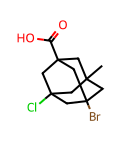
How many stereoisomers are possible for the adamantane with Br, Cl, and on its four bridgehead carbons?
Show answer and solution
2 (one pair of enantiomers), not . The four bridgehead carbons are stereocentres, but in this rigid cage their configurations are tied together: none can be inverted alone without breaking the cage. The molecule as a whole is chiral, so it has exactly two stereoisomers. (The original question describes this as one stereogenic centre at the middle of the cage.)