Basic Organic Chemistry: Reagents and Curly Arrows questions: Unsolved examples
4 questions, each with the answer and a worked solution under it. Try each one before you open the answer.
Draw the intermediate formed after pushing the arrows: (a) 1-bromo-1-methylcyclohexane loses (b) adds to acetyl chloride (c) adds to 2,3-dimethylbut-2-ene (bridged attack) (d) water opens an ethylene bromonium ion.
Show answer and solution
(a) the tertiary 1-methylcyclohexyl cation + . (b) the tetrahedral alkoxide . (c) the cyclic bromonium ion + . (d) (protonated 2-bromoethanol).
Complete the mechanisms by drawing the products: (a) removes the O-H proton of (b) an allylic bromide with a pendant group: the N lone pair attacks the C=C, the bond shifts and leaves.
Show answer and solution
(a) acetone + + (the alkoxide pushes out chloride). (b) an S2' cyclisation gives a bicyclic amine (as its HBr salt; after loss of HBr, the free secondary amine) with the C=C moved one position.
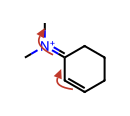
Mark all electrophilic carbon atoms in the iminium ion of cyclohex-2-enone with dimethylamine, , using resonance.
Show answer and solution
Two: the C=N carbon (C1) and the carbon (C3). In the second contributor the pair of C=C moves to C-C1 and the C=N pair moves to N, putting + on C3.
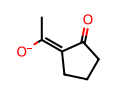
Draw all lone pairs and mark the nucleophilic atoms in the enolate of 2-acetylcyclopentanone (negative charge on the exocyclic O).
Show answer and solution
Three nucleophilic sites: the O bearing the negative charge, the ring C=O oxygen, and the central carbon (C2). Resonance spreads the charge over both oxygens through the central carbon: O-C=C-C=O O=C-C-C=O O=C-C=C-O.