Optical Isomerism (Stereochemistry) questions: Finding stereocentres
9 questions, each with the answer and a worked solution under it. Try each one before you open the answer.
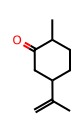
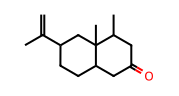
Mark the stereocentres in the compounds below (the original question labels the first "carvone" and the second "nootkatone").

Show answer and solution
First compound: 2 stereocentres (the ring carbon with and the ring carbon with the isopropenyl group). As drawn it has no ring C=C, so it is really dihydrocarvone; real carvone has one ring C=C and only one stereocentre. Second compound: the original question marks 3 (the ring carbon with , the ring-fusion carbon with , and the carbon with the isopropenyl group). The other ring-fusion carbon (with H) also has four different groups, so the drawn structure has 4. Butan-2-ol: 1 (C2).
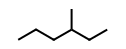
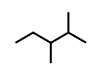
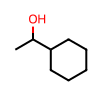
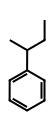
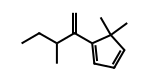
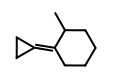
Each compound has one stereocentre. Find it.
Show answer and solution
(a) C3 (b) C3 (c) the CHOH carbon (d) the benzylic CH (e) the CH bearing the methyl (f) the ring carbon carrying the methyl (its two ring paths differ: one starts at the carbon).
Find the stereocentres in 1,2-dibromocyclohexane.
Show answer and solution
Two: C1 and C2. The other four ring carbons are .
Find all stereocentres.
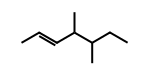

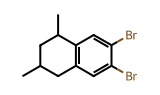

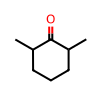
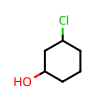
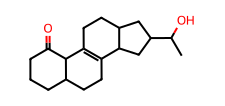
Show answer and solution
(a) 2 (b) 2 (c) 2 (d) 1 (e) 2 (C2 and C6; the original question stars only one) (f) 2 (g) 6: the two fusion CH of the ketone ring, the two fusion CH of the five-membered ring junction, the ring carbon carrying the side chain, and the side-chain carbinol carbon. (The two carbons of the ring C=C are not stereocentres.)
Which are chiral? Count the chirality centres.
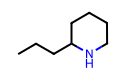
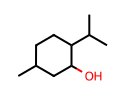
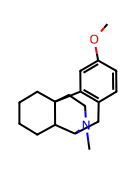
Show answer and solution
All three are chiral. Coniine: 1 (C2). Menthol: 3. Dextromethorphan: 3 carbon stereocentres. The original question gives 2 and 4 for coniine and dextromethorphan, counting the nitrogen as well; an amine N inverts rapidly and is not a stereocentre (in dextromethorphan the bridged N is held, but it is not usually counted).
Which have chirality centres? (a) 2-chlorobutane (b) 2-methylbutane (c) 3-bromo-3-methylhexane (d) ethanol (e) 3-bromopentane (f) but-3-en-2-amine. Which is chiral: 1-chlorobutane, 2-chlorobutane, 1-chloro-2-methylpropane, 2-chloro-2-methylpropane?
Show answer and solution
(a), (c), (f). Only 2-chlorobutane in the second list.
Sum of all stereocentres (a stereogenic C=C counts as two stereocentres, one per carbon) in: (I) 2-methyl-1-ethylidenecyclopropane (II) cis-2,3-dimethyl-1-ethylidenecyclopropane (III) 2-methyl-1-isopropylidenecyclopropane (IV) cis-2,3-dimethyl-1-isopropylidenecyclopropane.
- A8
- B9
- C10
- D11
Show answer and solution
(C) 10. (I) 1 + 2 = 3. (II) 2 + 2 = 4. (III) 1 (the isopropylidene C=C is not stereogenic). (IV) 2.
Label the two marked H atoms pro-R or pro-S: (a) the hydrogens of (S)-glyceraldehyde (b) the benzylic hydrogens of phenylalanine.
Show answer and solution
Replace each H in turn by D and assign R/S to the new stereocentre. Answer key answers: (a) left H pro-S, right H pro-R (b) left H pro-R, right H pro-S (for the drawings).
Rank the four groups on the stereocentre of 3-chloro-3-fluoro-2-methylpentane.
Show answer and solution
Cl (1) > F (2) > isopropyl (3, its carbon carries C,C,H) > ethyl (4, carbon carries C,H,H).