Hyperconjugation questions: Exercise: single choice
9 questions, each with the answer and a worked solution under it. Try each one before you open the answer.
Name the type of delocalisation: Q1 written as + cyclopropane; Q2 written as + two ethene. Options: (A) hyperconjugation (B) simple conjugation (C) homoconjugation (D) homohyperconjugation (Q1) / double hyperconjugation (Q2)
Show answer and solution
Q1 (D) homohyperconjugation: the C-Si bond interacts with the empty p orbital through one extra carbon. Q2 (D) double hyperconjugation: two bonds in a row take part.
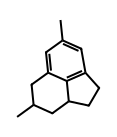
Number of benzylic carbons:
- A4
- B3
- C1
- D2
Show answer and solution
Answer key: (A) 4: the aryl methyl carbon and the three ring carbons of the saturated rings that are joined directly to the benzene ring. (The drawing here is a redraw of the original question's tricyclic skeleton.)
Q4: number of - (hyperconjugative) structures in the 3-methylpentan-3-yl cation. Q5-Q7: number of -H.
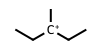
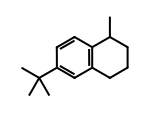
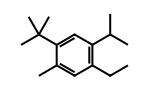
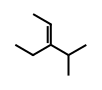
Q4: (A) 4 (B) 6 (C) 7 (D) 8. Q5: (A) 2 (B) 3 (C) 4 (D) 5. Q6: (A) 5 (B) 6 (C) 7 (D) 8. Q7: (A) 5 (B) 6 (C) 7 (D) 8
Show answer and solution
Q4 (C) 7 (2 + 2 + 3). Q5 (B) 3: the benzylic CH bearing the methyl (1) and the benzylic (2); the tert-butyl carbon has no H. Q6 (B) 6: ethyl 2, methyl 3, isopropyl 1, tert-butyl 0. Q7 (B) 6: on the alkene carbons sit an ethyl (2), an isopropyl CH (1) and a methyl (3).
number of hyperconjugative structures of norbornene.

Show answer and solution
(A) 0. The only -H are on the bridgeheads; their C-H bonds cannot line up with the orbital (Bredt's rule).
rank by stability. Q8: (A) 0 (B) 1 (C) 2 (D) 3. Q9: (A) a > b > c (B) a > c > b (C) c > b > a (D) b > a > c
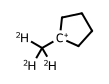

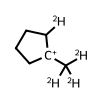
Show answer and solution
(D) b > a > c. C-H hyperconjugates better than C-D; (c) has the fewest C-H bonds.
delocalisation involving orbitals is called:
- Ainductive
- Bhyperconjugation
- Celectromeric
- Dmesomeric.
Show answer and solution
(B).
how many bonding MOs does the allyl radical have?
- A1
- B2
- C3
- D4
- E5
Show answer and solution
(A) 1 (; is non-bonding, antibonding).
Which alkenes are more stable than but-1-ene?
- Acis-but-2-ene
- Btrans-but-2-ene
- Cisobutene
- Dethene
Show answer and solution
(A), (B), (C): all are disubstituted (6 -H) against 2 for but-1-ene.
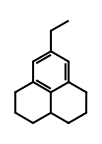
I1: X = total -H in the compound below. I2: how many of these show "-hyperconjugation": toluene, m-xylene, , , the 4-tert-butylbenzyl cation, ? I3: total -H in the compound below (I3).
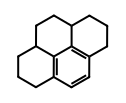
Show answer and solution
I1 7: the ethyl (2), the two benzylic (4), the benzylic CH (1). I2 Answer key 2: the intended meaning is hyperconjugation by C-C bonds (tert-butyl groups), found in the tert-butyl cation and the 4-tert-butylbenzyl cation. By the usual C-H definition, five of the six (all except the 4-tert-butylbenzyl cation) show hyperconjugation. I3 6: count H on every carbon bonded directly to the benzene ring: two benzylic (4 H) and two ring-junction CH (2 H).