Conformations questions: Subjective
4 questions, each with the answer and a worked solution under it. Try each one before you open the answer.
Identify the chair or boat six-membered rings in these structures and say why that shape is adopted.


Show answer and solution
(1) a simple chair with all substituents equatorial. (2) the six-membered ring is a boat: the one-atom O bridge forces it, a chair is impossible. (3) the six-membered ring can be a chair: the cage has some freedom. (4) three boats; the cage has no choice. (5) adamantane: four chairs (a small piece of the diamond lattice); no choice. (6) twistane: its rings are twist-boats; no choice.
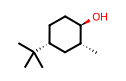
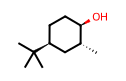
Draw clear conformational drawings for these molecules, labelling each substituent as axial or equatorial.

Show answer and solution
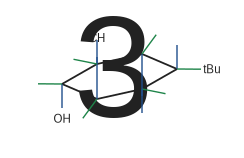
(a) trans-2-methylcyclohexanol has a free choice: it puts both groups equatorial.
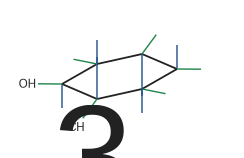
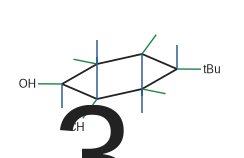
(b) and (c) are fixed by the tert-butyl group, which must be equatorial. In (b) OH and Me are then both equatorial; in (c) both are axial.
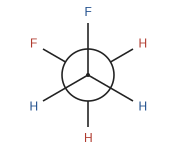
unlike , prefers the gauche conformer, even in the gas phase. Explain.
Show answer and solution
in the gauche form each C-F bond is anti to a C-H bond. The good donor C-H orbital then overlaps with the very low-lying C-F orbital (hyperconjugation), and this happens twice. In the anti form each C-F is anti to the other C-F, a poor donor. F is also small, so gauche steric repulsion is minor.
(a) What is the gauche effect? Give examples. (b) Draw the eclipsed and bisecting conformations of propene.
Show answer and solution
(a) The gauche effect is the preference for a gauche arrangement when the groups A and B on adjacent atoms are electronegative (F, O, N) or are lone pairs: , , hydrazine (, lone pairs gauche). (b) In propene the "eclipsed" form (a C-H of the methyl eclipsing the C=C) is the more stable one; in the "bisecting" form the C=C bisects the H-C-H angle.