Conformations questions: Solved examples
4 questions, each with the answer and a worked solution under it. Try each one before you open the answer.
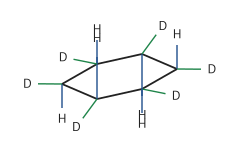
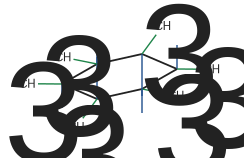
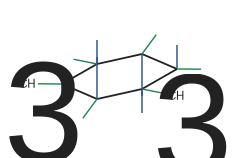
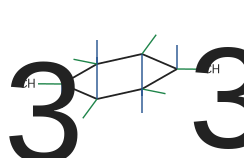
In the chair below, label each H and each D as axial or equatorial.
Show answer and solution
Every H is axial (parallel to the ring axis, alternating up and down round the ring). Every D is equatorial (pointing outward, roughly in the mean plane of the ring). Each carbon has one axial and one equatorial bond. Each equatorial bond is parallel to the ring bonds once removed (C1 equatorial is parallel to C2-C3).
Draw 1,2,3,4,5,6-hexamethylcyclohexane with (a) all methyls axial (b) all methyls equatorial.
Show answer and solution
Both are the same stereoisomer (all-trans, alternating up and down). In one chair all six methyls are axial; ring flip puts all six equatorial. The all-equatorial chair is far more stable.
Draw the lowest-energy chair of (a) cis-1,3-dimethylcyclohexane (b) trans-1,4-dimethylcyclohexane (c) trans-1-bromo-4-methylcyclohexane (d) trans-3-tert-butylcyclohexanol.
Show answer and solution
(a) both methyls equatorial (b) both equatorial (c) Br and both equatorial (d) tert-butyl equatorial, so the OH (trans-1,3) is axial.
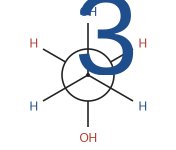
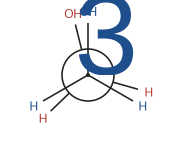
For each molecule, draw the Newman projections (along the marked bond) of the most and least stable conformations and estimate the energy difference: (a) (b) (c) (barrier 17 kJ/mol; why?) (d) .
Show answer and solution
(a) Isobutane: staggered vs eclipsed, with two /H (6.0 each) and one H/H (4.0) eclipsing: 16 kJ/mol. (b) Most stable: staggered, with the C4 methyl anti to one C1 methyl (only one gauche Me/Me, 3.8 kJ/mol). Least stable: / eclipsed (11) + /H (6) + H/H (4) = 21 kJ/mol. (c) Least stable: /OH eclipsed plus two H/H (4 + 4). The total barrier is 17 kJ/mol, so the /OH eclipsing costs about 17 - 8 = 9 kJ/mol. (d) Barrier similar to ethane's, with the O lone pairs playing the part of the back-carbon groups.