Bond Length and Bond Energy from Resonance questions: Exercise: single choice
13 questions, each with the answer and a worked solution under it. Try each one before you open the answer.
Compare the strength of the indicated C-H bonds. Q1: in the alkene below, H1 vinylic, H2 on a primary -type carbon, H3 allylic. Q2: in the alkylbenzene below, H1 aromatic, H2 benzylic, H3 on the tertiary carbon of the side chain. Q3: in 2-methylbutane, H1 on the tertiary carbon, H2 on a primary carbon.

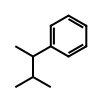

Q1: (A) 1 > 2 > 3 (B) 3 > 1 > 2 (C) 2 > 1 > 3 (D) 2 > 3 > 1. Q2: (A) 1 > 3 > 2 (B) 3 > 1 > 2 (C) 2 > 1 > 3 (D) 2 > 3 > 1. Q3: (A) 1 > 2 (B) 1 = 2 (C) 2 > 1 (D) cannot be predicted
Show answer and solution
Q1 (A). Vinylic C-H is strongest ( C, unstabilised radical); allylic C-H is weakest. Q2 (A) 1 > 3 > 2. Aryl C-H strongest, benzylic weakest. Q3 (C) 2 > 1. A tertiary radical is more stable, so the tertiary C-H is weaker.
ease of H-atom abstraction:
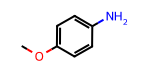
- A3 > 2 > 1
- B3 < 2 < 1
- C3 < 2 > 1
- D3 > 2 < 1.
Show answer and solution
(A).
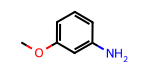
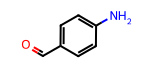
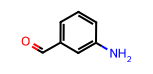
which C-N bond is strongest?
Show answer and solution
(C): the para CHO pulls the N lone pair through the ring (push-pull), giving the C-N bond the most double-bond character. +M of OMe at para works against this; meta groups cannot do it by resonance.
Which statement is NOT correct?
- AAmines are stronger bases than water.
- BIn the gas phase basicity is .
- CThe C-N bond in aniline is shorter than the C-N bond in HCN.
- DAn aromatic compound has electrons in the ring.
Show answer and solution
(C). HCN has a CN triple bond (116 pm); aniline's C-N is about 140 pm.
compare bond a (a C-C bond of cyclohex-2-enone, in the conjugated part) with bond b (the corresponding bond in cyclohex-3-enone, not conjugated).


Show answer and solution
(B) a < b: conjugation shortens the single bond in the enone.
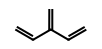
compare bond a (a C-C single bond in linear hexa-1,3,5-triene) with bond b (the C-C single bond in cross-conjugated 3-methylenepenta-1,4-diene). Options (both):

- Aa > b
- Ba < b
- Ca = b
- Dcannot be predicted
Show answer and solution
(A) a > b (original: the linear system gives the end bonds more single-bond mixing; the cross-conjugated bond gains less double-bond character). Note: the effect is small; the original question's own explanation states that bond a has extended conjugation and bond b cross conjugation.
compare the three S-O bonds a, b, c in .
Show answer and solution
(C): three equivalent contributors.
compare the C-N bond a in buta-1,3-dien-1-amine, with the C-N bond b in .
Show answer and solution
the CHO group pulls the N lone pair strongly (-M), so bond b has more double-bond character and is shorter: a > b. The original question's key prints (B), but its own explanation ("bond b has more double bond character") gives a > b, option (A).
compare a C-C bond of benzene (a) with the C=C of ethene (b). Q9 options: (A) a < b = c (B) a > b = c (C) a = b = c (D) cannot compare. Q10, Q11: (A) a > b (B) a < b (C) a = b (D) cannot be predicted
Show answer and solution
(A): 139 pm > 134 pm.
C=O bond lengths in (a) cyclohex-2-enone (b) cyclohexanone (c) cyclohexa-2,5-dienone.
Show answer and solution
(B) c > a > b: more conjugation with C=C gives the C=O more single-bond character.
C-O bond lengths in (a) phenol (b) cyclohexanol (c) 4-hydroxybenzaldehyde. Q12: (A) a > c > b (B) c > a > b (C) b > c > a (D) b > a > c. Q13: (A) a > c > b (B) c > a > b (C) b > c > a (D) b > a > c
Show answer and solution
(D) b > a > c: cyclohexanol has a pure single bond; in 4-hydroxybenzaldehyde the O lone pair is pulled through the ring by CHO, giving C-O the most double-bond character.
compare bond orders: a and b, the two C-O bonds of acetate; c and d, two S-O bonds of methanesulfonate.
Show answer and solution
(B): 1.5 for each C-O; 1.33 for each S-O.
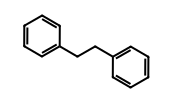
order of increasing C-C bond strength in 1,2-diphenylethane: (i) a ring C-C bond (ii) the Ph- bond (iii) the central bond. Q14: (A) a = b = c = d (B) a = b > c = d (C) a = b < c = d (D) cannot be compared. Q15: (A) i < ii < iii (B) i < iii < ii (C) ii < iii < i (D) iii < ii < i (E) iii < i < ii
Show answer and solution
(D): the central bond breaks to give two stabilised benzyl radicals (weakest); the aromatic ring bond (order 1.5) is strongest.