Alkenes questions: Solved examples
8 questions, each with the answer and a worked solution under it. Try each one before you open the answer.
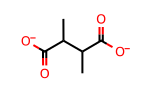
Predict the products of electrolysis of: (i) sodium benzoate (ii) sodium 2,3-dimethylsuccinate.
Show answer and solution
(i) The original question gives biphenyl, Ph-Ph (two phenyl radicals couple). In practice, aryl carboxylates do not decarboxylate well under Kolbe conditions, so the yield is poor. (ii) But-2-ene as a mixture of cis and trans: both carboxylate radicals lose while the new C=C forms; the two groups can be syn or anti in the conformation that reacts.
2-Methylpropene + HBr gives 2-bromo-2-methylpropane. (a) Write the mechanism. (b) Why does the pair attack the H end of HBr? (c) Why is the product not the primary bromide?


Show answer and solution
(a) bond H, H-Br bond Br; then C+. (b) H is the end of H-Br, and the empty (LUMO) of H-Br is largest on H. (c) Protonation at gives the tertiary cation; protonation at the other carbon would give a primary cation. The tertiary cation is far more stable, so its transition state is lower in energy (lower ), and it forms much faster.
1-Methylcyclohexa-1,4-diene with catalytic and 1 equivalent of . (a) Major product and mechanism. (b) Products with a second equivalent of water. (c) What happens without acid?

Show answer and solution
(a) protonates the trisubstituted C=C at C2, giving the tertiary cation at C1 (the disubstituted C=C would give only a secondary cation). Water attacks, then loses : 1-methylcyclohex-3-en-1-ol. (b) The remaining C=C is hydrated too; both of its carbons give secondary cations, so a mixture of 1-methylcyclohexane-1,3-diol and 1-methylcyclohexane-1,4-diol forms. (c) Essentially no reaction: water is far too weak an acid to protonate the alkene. is needed to make the H electrophilic enough.
Compare cyclohexene with (i) dilute cold and (ii) m-CPBA then .
Show answer and solution
(i) Syn addition through a cyclic manganate ester: cis-cyclohexane-1,2-diol (meso). (ii) The epoxide is opened by water from the back side (anti): trans-cyclohexane-1,2-diol, a racemic pair.
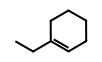
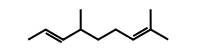
(a) 1-ethylcyclohexene (b) (c) the diene

Show answer and solution
(a) One product with two C=O: (7-oxononanal; the ring opens). (b) Symmetrical alkene: two molecules of propanal. (c) Each C=C is cut: acetone from one end, acetaldehyde from the other, and the middle becomes (2-methylpentanedial). Note: the original question's answer drawing shows succinaldehyde + propanal + acetone, which belongs to a different diene (no methyl branch, ethyl at the end).
Which alkenes give: (a) acetone + butanal? (b) hexanedial as the only product? (c) cyclopentanone + propanal?
Show answer and solution
(a) , 2-methylhex-2-ene. (b) one product with two C=O means the alkene was in a ring. The C=O groups are at C1 and C6, so join C1 and C6 by a double bond: cyclohexene. (c) propylidenecyclopentane, a ring C=CH-.
Ozonolysis of o-xylene gives glyoxal, butane-2,3-dione and methylglyoxal (pyruvaldehyde). In what ratio would they form if o-xylene were a resonance hybrid of its two Kekule structures? The found ratio was 3: 1: 2. What follows?

Show answer and solution
Kekule form I (C=C between the two methyl carbons) gives 1 butanedione + 2 glyoxal. Form II (methyl carbons on different C=C) gives 2 methylglyoxal + 1 glyoxal. Equal weight of I and II: glyoxal 3, butanedione 1, methylglyoxal 2, exactly as found. So both Kekule structures contribute equally; the ring bonds are equivalent (resonance), and ozone "sees" both bonding patterns.
Products of hot with: ethene, propene, 2-methylpropene.
Show answer and solution
Ethene: , which is further oxidised to . Propene: . 2-Methylpropene: acetone + .