Alkanes questions: Questions from the chapter
7 questions, each with the answer and a worked solution under it. Try each one before you open the answer.
The sodium salt of which acid is needed to make propane by soda-lime decarboxylation? Write the equation.
Show answer and solution
Butanoic acid (one carbon more than propane).
Which alkane can be made by the Wurtz reaction in good yield?
- An-pentane
- Bisopentane
- C2,3-dimethylbutane
- D2,2-dimethylbutane
Show answer and solution
(C). It is symmetric: two isopropyl halides couple, . The others need two different halides and would give mixtures.
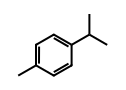
Draw the main product of radical bromination of: (a) butane (b) 2-methylbutane (c) 4-isopropyltoluene (p-cymene) (d) pent-1-ene.



Show answer and solution
(a) 2-bromobutane (secondary H). (b) 2-bromo-2-methylbutane (tertiary H). (c) the tertiary benzylic H: 2-bromo-2-(4-methylphenyl)propane. (d) allylic H: the allyl radical gives two products, 3-bromopent-1-ene and 1-bromopent-2-ene.
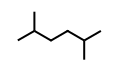
How many monochlorides (structural isomers only) form from each alkane?



Show answer and solution
(a) 3 (b) 3 (c) 5 (d) 1 (e) 5 (f) 4 (g) 2 (h) 4. Count the sets of equivalent H atoms. The original question also lists (i) = 4, but its structure is not printed.
(a) cyclohexane (b) methylcyclopentane (c) decalin (d) hexane (e) ethylbenzene (f) -octalin (two products).
Show answer and solution
(a) bromocyclohexane. (b) 1-bromo-1-methylcyclopentane (tertiary). (c) 9-bromodecalin (tertiary ring-junction C). (d) 3-bromohexane and 2-bromohexane are close; the original question gives 3-bromohexane. (e) 1-bromo-1-phenylethane (benzylic). (f) two allylic bromides: substitution at C1 directly, and at the ring-junction carbon after the double bond shifts (allylic rearrangement).
Explain: (a) (100 C) boils higher than (65 C) (b) higher than (-33 C) (c) higher than HF (20 C) (d) HF higher than .
Show answer and solution
(a) water has two O-H and two lone pairs, so it forms up to four H-bonds; methanol has only one O-H. (b) O is more electronegative than N, so O-H...O bonds are stronger; water also has as many donors as acceptors. (c) HF has stronger single H-bonds, but each molecule has only one H, so it forms on average two H-bonds (chains); water forms about four (3D network). (d) F is much more electronegative than N, so HF hydrogen bonds are much stronger than those of .
KIE = rate of C-H cleavage / rate of C-D cleavage by . Will chlorination or bromination show the larger deuterium KIE?
Show answer and solution
Bromination. H abstraction by is endothermic, so its transition state is late: the C-H(D) bond is almost broken and the zero-point energy difference between C-H and C-D is almost fully felt. Chlorination has an early transition state with the bond only slightly stretched, so the isotope effect is smaller.